Groom Attire
Dinner Jacket vs Tuxedo: What the Difference Means for the Groom
The two words named the same garment on opposite sides of the Atlantic — here is what actually changes for him, and when a contrast dinner jacket reads correctly.
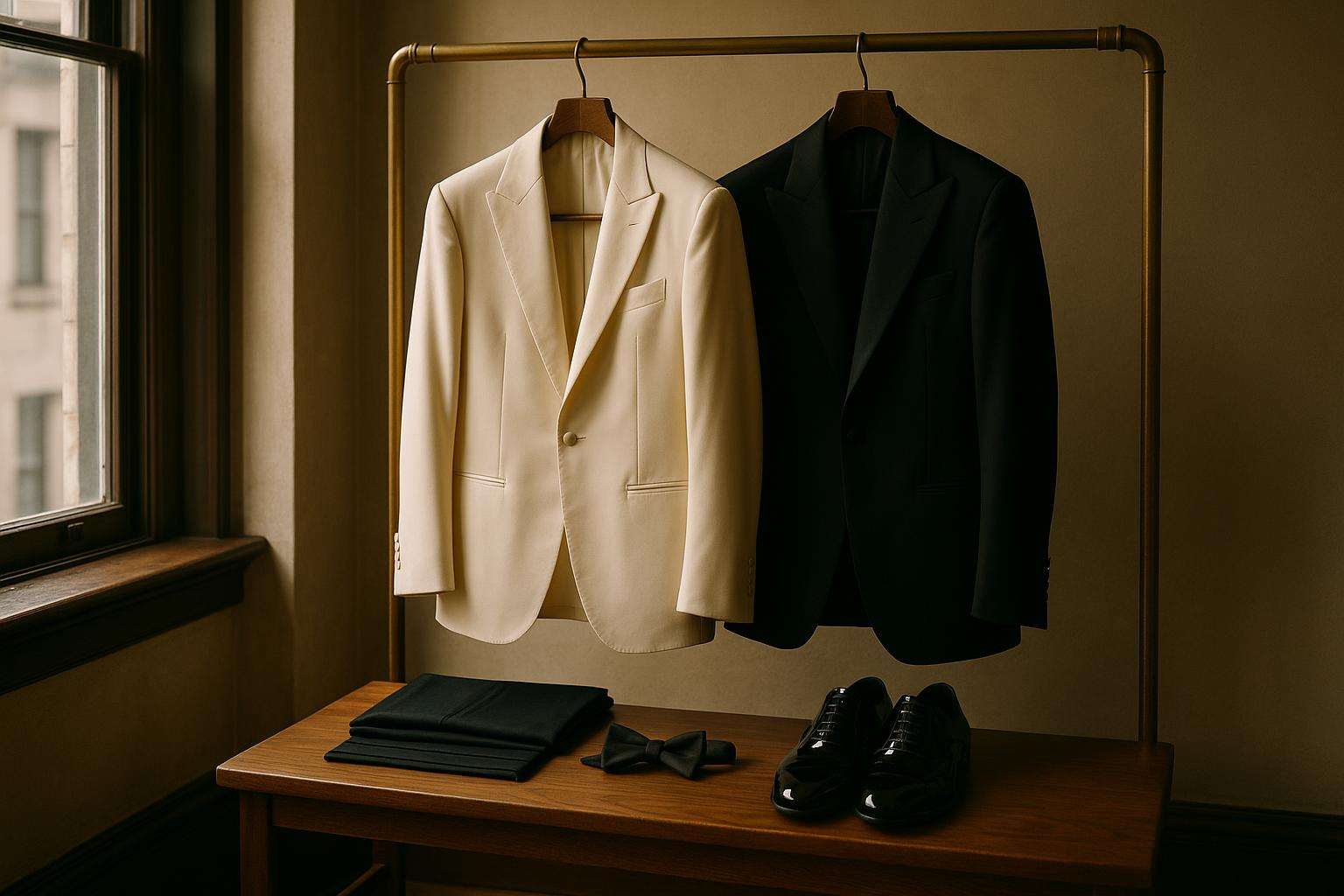
Historically, "dinner jacket" and "tuxedo" are the same garment named differently in Britain and America. In modern American practice, though, "dinner jacket" usually signals the ivory contrast jacket: a warm-weather sub-category of black tie. A black or midnight tuxedo is the year-round default for any "black tie" invitation; the ivory dinner jacket is the situational choice for summer, outdoor, and destination weddings. The test is simply season + venue + how the invitation reads.
If you are planning his look and the words keep slipping past each other, you are not imagining it. "Dinner jacket" and "tuxedo" are two of the most-confused terms in menswear, and the confusion is older than either of you. The good news is that once you understand why there are two words, the decision about what he should wear becomes refreshingly clear — and it comes down to a handful of concrete, visible details rather than vague taste.
Is a dinner jacket the same thing as a tuxedo?
In origin, yes. The evening jacket with silk-faced lapels was popularized in the United States at Tuxedo Park, New York, in the 1880s, which is where Americans got the word tuxedo. The British, who had been wearing the same coat for evening, called it — and still call it — a dinner jacket. So at the level of pure vocabulary, the two words name one garment on opposite shores of the Atlantic, and they remain interchangeable.
What has happened since is a useful drift in American speech. When an American says "dinner jacket" today, he very often means something more specific: the white or ivory contrast jacket worn with black trousers, as distinct from the all-black tuxedo. That narrower meaning is exactly the distinction the two of you actually need, because it governs when each version is correct on a wedding day. The Black Tux frames the modern choice the same way.
What actually makes a contrast dinner jacket different from a black tuxedo?
Set the words aside and look at the cloth. The differences between an ivory dinner jacket and a black tuxedo are specific and easy to see once you know where to look:
| Detail | Contrast dinner jacket | Black tuxedo |
|---|---|---|
| Color | Cream, ivory, or off-white (never stark white) | Black or midnight blue |
| Lapel facing | Traditionally self-faced (same cloth, no silk) | Silk satin or grosgrain facing |
| Lapel shape | Shawl or peak | Shawl or peak (never notch) |
| Trousers | Black formal trousers, usually no side stripe | Matching black trousers with satin stripe |
| Cloth / weight | Lighter — tropical wool or linen blend | Mid-weight wool |
| Best season | Warm weather, summer | Year-round |
A few of these are worth underlining for him. The color should be a soft ivory or cream rather than a bright white — pure-white coats historically read as military mess dress or a waiter's jacket, as Gentleman's Gazette explains. The lapel must be a shawl or peak; a notch lapel makes the jacket read as an ordinary sport coat. And the trousers do real work: they should be proper black formal trousers cut from tuxedo cloth, not the matte black slacks he already owns. Everything below the jacket — bow tie, cummerbund, socks, shoes — stays black, which is what keeps the ivory jacket firmly at black-tie formality.
When does a contrast dinner jacket read correctly for a groom?
This is the part that matters most on the day. A white or ivory dinner jacket and a black tuxedo sit on the same formality tier — both are black tie — but the dinner jacket is situational where the tuxedo is universal. The ivory jacket entered the wardrobe in the early 1930s precisely so well-dressed men could keep their formality in tropical heat without sweating through dark wool, and that is still exactly where it belongs.
It reads right at warm-weather, summer, and destination weddings; in outdoor, garden, vineyard, beach-adjacent, and resort settings; and when an invitation says "black-tie optional," "summer formal," or "warm-weather black tie." It reads wrong at a winter wedding, a formal indoor ballroom in the cold months, or any invitation that simply says "black tie" — there the black or midnight tuxedo is the only safe default, as menswear guides such as Generation Tux consistently advise. So the test you can apply together is short: season, venue, and how the invitation reads. A July garden reception can carry an ivory dinner jacket magnificently; a December ballroom cannot.
Should the groom rent or buy his tuxedo or dinner jacket?
The honest answer turns on frequency. If this wedding is a one-time occasion, renting is sensible. Tuxedo rentals in 2026 generally run roughly $150 to $300 — The Knot's Real Weddings data puts the average near $205 — with the jacket, trousers, shirt, and bow tie typically included, plus optional accessory and damage-waiver add-ons. If he attends black-tie events more than once a year, buying outright tends to pay off, and an owned, properly altered tuxedo nearly always looks more considered than a rental.
The houses sort neatly along this line. The Black Tux rents both black tuxedos and white dinner jackets with a home try-on. SuitSupply does not rent — it sells, separating dinner jackets (including velvet and ivory) from black tuxedos in its black-tie collection, cut from Italian mill cloth such as Vitale Barberis Canonico. At the luxury end, Tom Ford offers evening jackets in fits like the Shelton and Atticus, in black, midnight, and statement ivory, holding to the classic rules of shawl or peak lapels and a self-tie bow tie that matches the facing. Whatever the budget tier, the deciding factor is the same: nothing — rented or bought — looks right unaltered, so build the fitting timeline in early.
So which should he wear?
Default him to a black or midnight tuxedo and you will never be wrong; it is the universal answer to "black tie," it photographs cleanly in any season, and it is the easier garment to rent or buy well. Reach for the ivory dinner jacket only when the day genuinely calls for it — a warm-weather, outdoor, or destination wedding where it can do what it was invented to do. Treat the words as a clue rather than a trap: "tuxedo" almost always means the safe black default, and "dinner jacket," in modern American shorthand, usually means the romantic, situational ivory alternative. Match the jacket to the season and the setting, get it tailored properly, and he will look exactly as he should — like himself, on a very good day.
Frequently asked
Is a dinner jacket the same thing as a tuxedo?
In origin, yes — they are simply the British and American names for the same evening jacket. The garment was popularized in the United States at Tuxedo Park, New York, in the 1880s, which gave Americans the word tuxedo, while the British have always called it a dinner jacket. At the level of pure terminology they are interchangeable. What has shifted is everyday American usage: when an American says "dinner jacket" today he often means specifically the ivory or white contrast jacket worn with black trousers, as opposed to the all-black tuxedo. So both can be correct depending on who is speaking — see The Black Tux for the modern split.
Can the groom wear a white dinner jacket to his own wedding?
He certainly can, provided the season and setting fit it. An ivory or cream dinner jacket is genuinely elegant for a warm-weather, summer, outdoor, or destination wedding, and it photographs beautifully against greenery and golden light. The cautions are simple: choose cream or ivory rather than stark white, keep the lapel a shawl or peak shape, and pair it with proper black formal trousers, a black self-tie bow tie, and polished black shoes. For a cold-weather indoor ballroom, the black or midnight tuxedo will read better. The jacket is not less formal — it is simply more situational.
What color should a groom's dinner jacket actually be?
Cream or off-white, not bright white. As Gentleman's Gazette notes, pure-white coats historically read as military mess dress or a waiter's jacket, so a soft ivory or ecru is the more refined choice and is kinder against most skin tones in photographs. The classic contrast dinner jacket is also traditionally self-faced — the lapel is the same cloth as the body, with no contrasting silk — which is part of what visually separates it from a black satin-faced tuxedo.
Does a dinner jacket require black tie accessories?
Yes — the contrast dinner jacket is worn with the full black-tie kit, just with a lighter jacket on top. That means black formal trousers cut from tuxedo wool, a black self-tie bow tie, a black cummerbund or low evening waistcoat, black socks, and black patent or highly polished oxford shoes. The one detail grooms get wrong is the trousers: ordinary black slacks are too matte and casual. Keeping every element black below the jacket is what holds the look firmly at black-tie formality rather than letting it drift toward a summer sport coat.
Should the groom rent or buy his tuxedo or dinner jacket?
It comes down to how often he will wear it. If the wedding is a one-time occasion, renting from a house like The Black Tux is sensible — rentals in 2026 generally run roughly $150 to $300, with the jacket, trousers, shirt, and bow tie included. If he attends black-tie events more than once a year, buying outright from a retailer such as SuitSupply often pays off, and a well-fitted owned tuxedo always looks more considered than a rental. The deciding factor, in both cases, is fit — neither rented nor bought looks right unaltered.
When does a contrast dinner jacket look wrong on a groom?
It looks out of place in cold weather, in a formal indoor ballroom during winter, and any time the invitation simply reads "black tie" with no warm-weather qualifier — in those cases the black or midnight tuxedo is the only safe default. The ivory dinner jacket entered formal wardrobes in the 1930s specifically as a warm-climate alternative, and it still belongs to that world: summer, garden, vineyard, beach-adjacent, resort, and destination settings, or an invitation that says "summer formal" or "black-tie optional." Use season, venue, and the invitation wording as the test.