Accessories
Cufflinks, Tie Bars & Lapel Pins: The Small-Metal Rules
The three small pieces of metal on his finished look — cufflinks, tie bar, lapel pin — and the quiet rules that make them read intentional rather than busy.
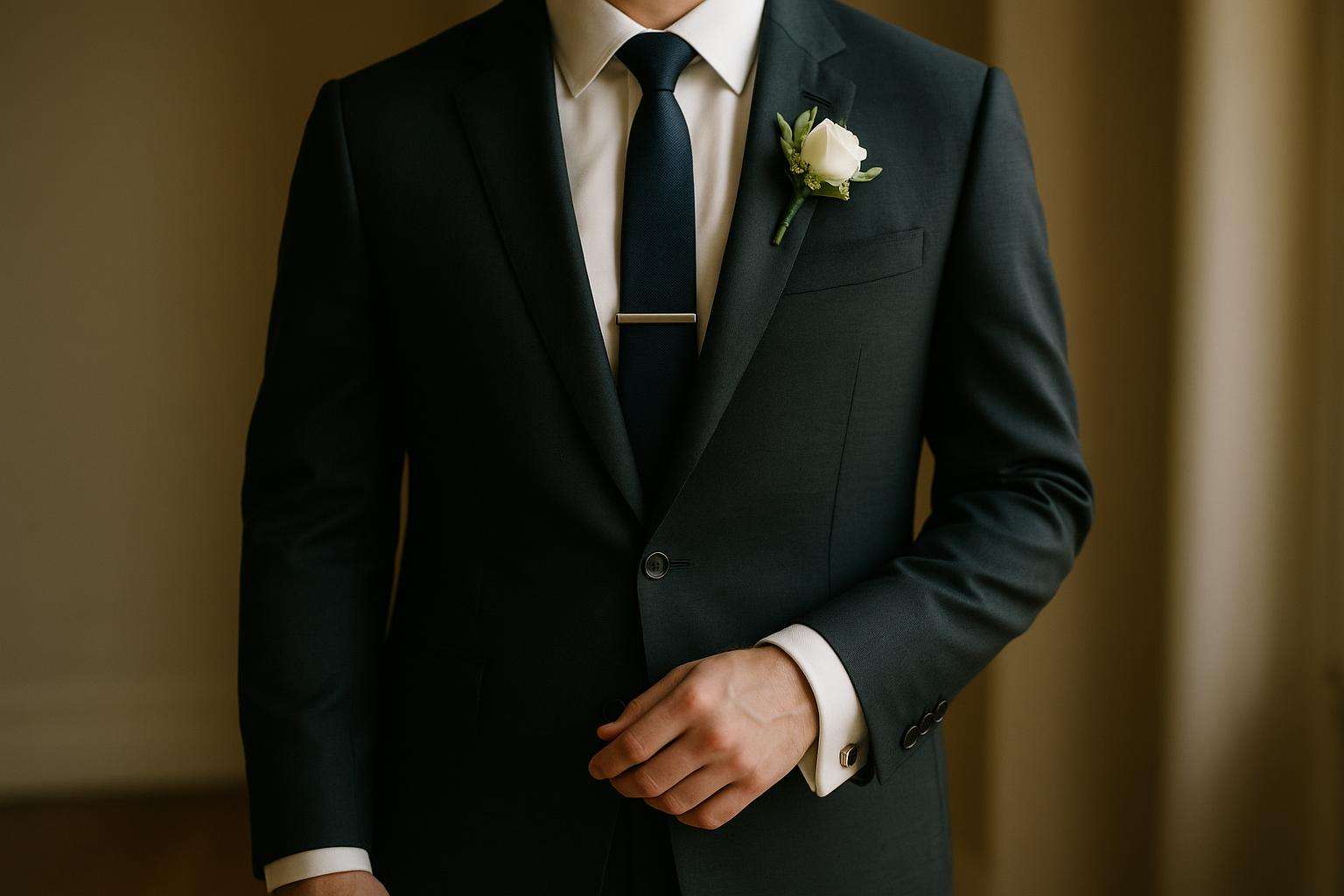
By the time the suit fits and the tie is knotted, what is left is the small metal — the pieces most grooms think least about and photographers shoot most closely. Cufflinks, a tie bar, a lapel pin: each is tiny, each has its own quiet rules, and each can either finish the look or quietly undo it. If you are helping him pull the day's outfit together, these are the three to understand. None of them is complicated. They simply reward a little attention.
The short version: Cufflinks require a French-cuff shirt — a standard button cuff cannot take them. A tie bar goes between the third and fourth shirt buttons and should never be wider than the tie. A lapel pin and a boutonniere are an either/or, never both. And the one rule that governs all of it: keep every metal he wears in the same tone.
What kind of shirt do cufflinks actually need?
This is the question that trips up more grooms than any other, so it is worth settling first. Cufflinks only work with a French cuff — the long cuff that folds back on itself so two buttonholes align, and the link passes through all four layers to hold them shut. The everyday shirt has a barrel cuff: a single cuff with its own button sewn in place. A barrel cuff has no second buttonhole and simply will not accept a link. So the very first move, before anyone admires a pair of cufflinks, is to confirm the shirt is a French cuff — and to verify it with the rental shop or tailor, as Winslow Style advises, rather than discovering the mismatch on the morning of the wedding.
Worn properly, the link's decorative face shows when his arms hang at his sides, sits flush so it does not snag the jacket sleeve, and leaves about a half-inch of shirt cuff visible past the jacket. Because French cuffs are inherently dressy, they ask for neckwear — they look unfinished with an open collar. For a wedding, the safest styles are the classic bullet-back link or the double-sided silk knot; novelty or themed cufflinks undercut even a beautifully fitted suit. And scale matters — a large, heavy link on a slim suit with a narrow lapel looks out of proportion, so match the cufflink's weight to the cut of the suit.
Where does a tie bar go, and how wide should it be?
A tie bar is both jewelry and a small piece of engineering: it keeps the tie from swinging and adds a clean horizontal line across the shirt. Get two numbers right and it always looks correct. First, placement: set it between the third and fourth shirt buttons, counting down from the collar. Higher and it hides under the jacket lapel; lower and it looks lost. Second, width: a tie bar should never be wider than the tie, and about three-quarters of the tie's width is the sweet spot — roughly a 2¼-inch bar on a standard 3-inch tie, per He Spoke Style. An oversized bar overpowers the look; a tiny one disappears.
Two details separate the grooms who get it from those who do not. Wear it perpendicular — perfectly horizontal, never tilted at an angle — and clip it through both the tie and the shirt placket beneath, so it genuinely anchors the tie rather than merely decorating it. A nice professional touch is to blouse the tie up a touch before fastening the bar, which adds a little depth and keeps him from feeling pinned to his shirt. One more proportion note worth carrying upward: the tie's own width should roughly echo the jacket lapel, which keeps the entire front of the look in balance.
Lapel pin or boutonniere — and can he wear both?
Here the rule is refreshingly clear: he wears one or the other, never both. The boutonniere is the wedding-day classic — a single fresh flower or small sprig pinned to the left lapel, slightly above the heart, with the pin fed through the lapel buttonhole and hidden behind so no metal shows. The groomsmen's are coordinated but a touch simpler, which lets the groom stand out. Ask the florist to bring the right pin — black for darker suits, white for lighter — and, as SuitShop notes, to attach it so the pin stays invisible.
The lapel pin — a small metal flower or a fabric one that nods to the tie — is the modern alternative: budget-friendly, allergy-safe, and immune to wilting on a long, hot day. It sits on the same left lapel, set into the buttonhole or pinned about two inches below the notch. What you should not do is stack the two: a pin alongside a boutonniere crowds the lapel and reads costume-like in close photographs. At a wedding the boutonniere is the traditional answer and almost always the right one; save the lapel pin for black tie or a no-flowers look.
| Accessory | When he wears it | The rule that matters most |
|---|---|---|
| Cufflinks | Any time the shirt is a French cuff and he has neckwear | French cuff required; never a barrel cuff |
| Tie bar | With a tie, for polish and to anchor it | ~¾ the tie's width; 3rd–4th button; horizontal |
| Boutonniere | The wedding-day classic on the day itself | Left lapel, above the heart; hidden pin |
| Lapel pin | Black tie, or a modern no-flowers look | Left lapel; never worn with a boutonniere |
How does he keep all three from clashing?
This is the rule that quietly governs the other three: keep every metal in the same tone. Pick one finish — silver or white gold, yellow gold, rose gold, or gunmetal — and carry it through the cufflinks, the tie bar, the watch, the belt buckle, and a metal lapel pin if he wears one. Silver links with a gold tie bar create what stylists call visual noise, and the eye registers it even when no one can name what is wrong. As a starting point, silver and white-gold tones read cleanest with black or navy tuxedos, while warm yellow gold flatters a navy or tan suit.
The companion rule is restraint. Cufflinks, a tie bar, a lapel pin, a pocket square, and a boutonniere all at once is too much for nearly any wedding. A graceful default is cufflinks (if the shirt allows), a tie bar, and a boutonniere, with a simple pocket square — and let the formality of the day decide whether anything else earns its place. The goal is not to wear everything he owns; it is a finished, intentional look in a single metal tone. When something feels like one piece too many, it usually is — take it off, and the photographs will thank you.
Frequently asked
Do you need a special shirt to wear cufflinks?
Yes. Cufflinks only work on a French cuff (also called a double cuff) shirt — the kind whose long cuff folds back on itself so two buttonholes line up. The everyday barrel or button cuff has its own button sewn on and simply cannot take a link. So before he buys a handsome pair, confirm the shirt — or the rental package — is spec'd with French cuffs, and ask the shop or tailor to verify. If the look is a standard button-cuff shirt, the cufflinks have nowhere to go, and a last-minute swap on the morning of the wedding is the kind of small stress you can spare him.
Where exactly does a tie bar go, and how wide should it be?
Place the tie bar horizontally between the third and fourth shirt buttons, counting down from the collar. Higher and it disappears under the jacket lapel; lower and it looks like an afterthought. For width, the rule is simple: it should never be wider than the tie, with about three-quarters of the tie's width being ideal — roughly a 2¼-inch bar on a standard 3-inch tie, per He Spoke Style. One more detail: clip it through both the tie and the shirt placket, so it actually anchors the tie rather than just decorating it.
What is the difference between a lapel pin and a boutonniere?
A boutonniere is the classic: a small fresh flower or sprig pinned to the left lapel, slightly above the heart, with the pin tucked invisibly behind. A lapel pin is the modern stand-in — a small metal or fabric flower set into the lapel buttonhole. Boutonnieres feel ceremonial and photograph beautifully; lapel pins are budget-friendly, allergy-safe, and never wilt, which makes them a fair choice for a long, hot day. At a wedding, most grooms wear the boutonniere. The one firm rule, from SuitShop, is to choose one — not both.
Can he wear a lapel pin and a boutonniere at the same time?
No — pick one. Stacking a lapel pin behind or beside a boutonniere crowds the lapel and reads costume-like in close-up photographs, which is exactly where the wedding day lingers. On the day itself, the boutonniere is the traditional choice and it wins; the lapel pin is what he reaches for at a black-tie event or a more modern wedding where no flowers are in play. Think of them as two answers to the same question, not two pieces to layer. Keeping that single point of interest on the lapel is part of what makes a groom look composed rather than over-decorated.
Do cufflinks, the tie bar, and a metal lapel pin all need to match?
In metal tone, yes — and it is the single most important rule of the three. Choose one finish (silver or white gold, yellow gold, rose gold, or gunmetal) and carry it through every piece of metal he wears: cufflinks, tie bar, watch, belt buckle, and a metal lapel pin if he wears one. Silver links with a gold tie bar create what stylists call visual noise. As a starting point, silver and white-gold tones read cleanest with black or navy tuxedos, while warm yellow gold suits a navy or tan suit. Match the metals and the whole look quietly snaps together.
Does he need all three accessories at once?
Not at all — restraint is part of looking polished. Wearing cufflinks, a tie bar, a lapel pin, a pocket square, and a boutonniere all together is overkill for most weddings. A good default is cufflinks (if the shirt has French cuffs), a tie bar, and a boutonniere, with a simple pocket square. Let the occasion decide the rest. The aim is a finished, intentional look — a few well-chosen pieces in one metal tone — rather than a display of everything he owns. When in doubt, take one thing off; it almost always reads better in the photographs.