Accessories
Wedding Socks: The Detail Nobody Sees Until They Do
Socks are invisible until he sits, kneels, or crosses his legs — and then they are in every photo. How to choose length, color, and the right amount of fun for his big day.
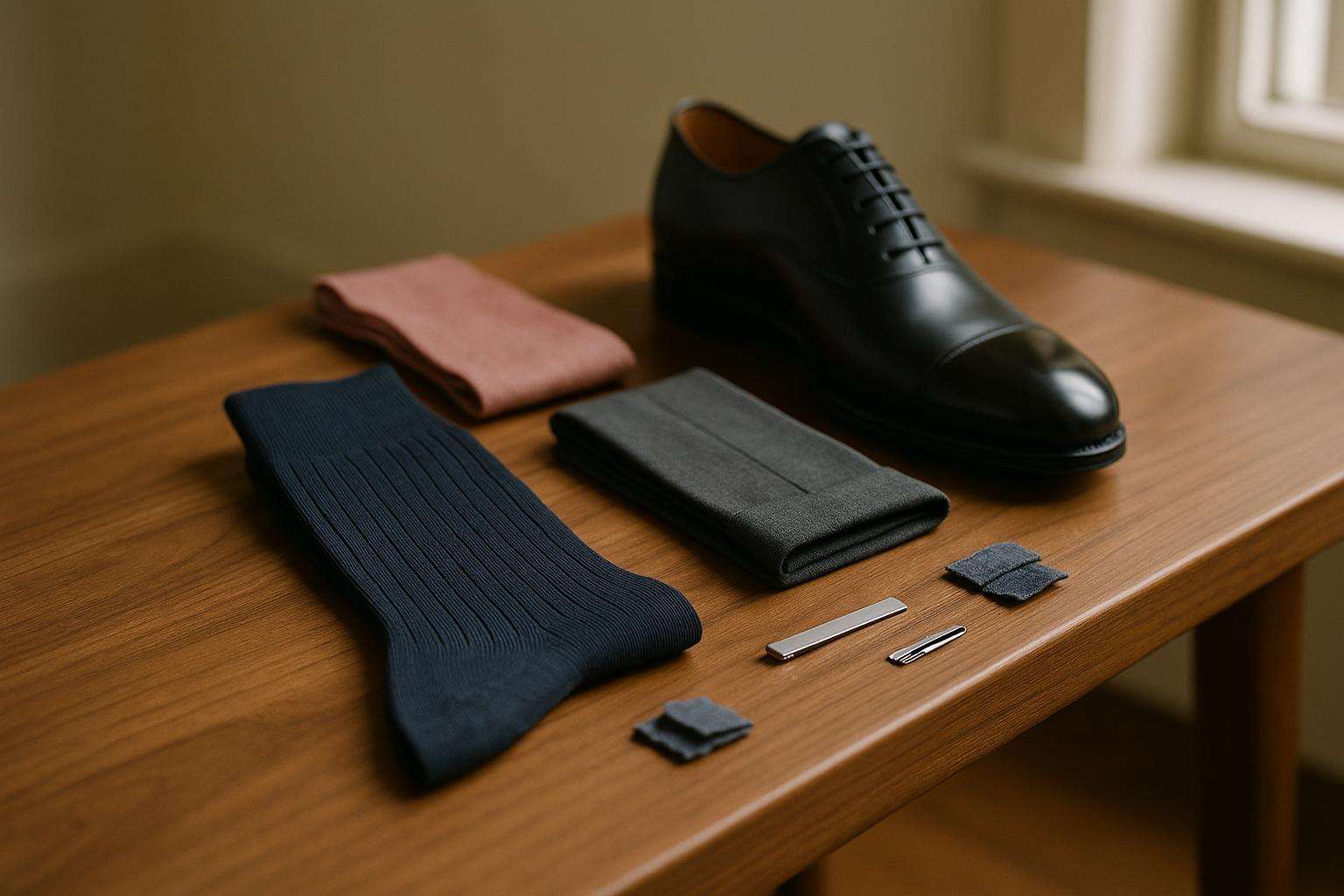
Put the groom and his men in over-the-calf socks so no bare leg ever shows when he sits or kneels, and match the sock color to the trousers, not the shoes — navy suit, navy socks; black tuxedo, black socks. A little color is fine if it comes from the wedding palette and stays tasteful, but keep the tuxedo crowd in solid black and save bold socks for the reception. Order the party's socks four to six weeks out.
Of every choice he makes for his wedding look, socks are the one that feels too small to think about — and the one most likely to turn up, uninvited, in the photographs. They are invisible right up until the moment he sits down for the toasts, kneels at the altar rail, or crosses a leg on the dance floor. Then a strip of bare shin appears between his trouser hem and his shoe, and it is there in the frame for good. The good news is that this is the easiest detail on the whole list to get perfectly right, and it costs very little to do so.
Why do socks matter at all on a wedding day?
The reason is mechanical, not fussiness. A groom spends his day seated, crossing his legs, kneeling, and dancing — and every one of those motions lifts the trouser hem. A short sock then exposes bare leg, and sock specialists describe sliding crew socks as "the number one sock-related photo problem at weddings." The single rule worth memorizing covers all of it: the sock should always be taller than the gap the trouser hem makes when he sits down. Get that one thing right and the detail simply disappears, which is exactly what you want it to do.
What length sock should the groom wear?
The answer for nearly every wedding is over-the-calf, the roughly sixteen-to-eighteen-inch length that is the recommended standard for suits and formalwear in both American and European menswear tradition. It guarantees full coverage when he is seated or climbing the church steps, and it stays up better than a mid-calf sock because the calf acts as an anchor that keeps the cuff from sliding down. Boardroom Socks frames the trade-off simply: if you want socks that stay up all day, choose over-the-calf.
Mid-calf, around twelve to fourteen inches, is a more casual length. It is acceptable for a smart-casual daytime wedding, runs cooler for a hot outdoor ceremony, and fits a groom with very large calves more comfortably — but it offers less coverage security and can creep down over a long day. The rule of thumb: the more formal the shoe and the dressier the occasion, the taller the sock.
| Dress code | Length | Color | Material |
|---|---|---|---|
| Black-tie (tuxedo) | Over-the-calf | Solid black only | Silk, fine merino, silk blend |
| Formal suit | Over-the-calf | Match the trouser | Merino, cotton, bamboo |
| Semi-formal | Over-the-calf preferred | Match or subtle pattern | Cotton blends |
| Casual / outdoor daytime | Mid-calf or OTC | Coordinate to palette | Lightweight cotton |
Should the socks match the trousers or the shoes?
This is the one rule that trips up almost every groom, and the answer is firm: match the socks to the trousers, not the shoes. Color is a structural element of the outfit, and a sock in the trouser's color extends the leg into one unbroken line from knee to shoe — which makes him look taller and reads as quietly elegant, particularly when he is seated. A sock that contrasts sharply with the trousers does the opposite, cutting a hard horizontal band across the ankle that breaks the line. As Gentleman's Gazette puts it, matching the sock to the trouser gives the most holistic, elegant transition between the pieces of an outfit.
In practice this is reassuringly easy. Navy suit, navy socks. Charcoal suit, charcoal socks. Black tuxedo, black socks. With a tuxedo the rule is strict and solid black is the only correct answer; with a regular suit there is a little room for a subtle pattern — a fine argyle or a thin stripe — provided it lives in the trouser's color family rather than fighting it.
Are fun or novelty socks okay for the groom and groomsmen?
They can be, with a little judgment, and they have become one of the most popular small flourishes for a wedding party. The most tasteful route is to draw the sock color from the wedding palette or the bridesmaids' dresses, aiming for the same color family rather than an exact match — exact matches across different fabrics and textures rarely look identical, and a near-miss is more jarring than a deliberate complement. A muted dusty-rose sock under a charcoal trouser, picking up a dusty-rose palette, is the kind of touch that photographs beautifully.
Two guardrails keep it elegant. First, save the bolder socks for the reception, not the formal ceremony line-up — the ceremony photos read better with restraint. Second, keep anyone in a tuxedo in solid black regardless of how playful the rest of the party gets. And steer everyone away from cheap synthetics, which trap heat and odor and sag, and from bulky cushioned athletic socks, which bunch and cause pressure points inside a snug dress shoe.
Which real brands should he actually buy?
Three names cover most grooms cleanly. Falke, the German house founded in 1895, makes the benchmark dress sock — its merino-wool-and-cotton "Airport" style is thermo-regulating with reinforced stress zones at the heel and toe, and it is offered in a knee-high, over-the-calf version as well as mid-calf. Bombas Dress Calf socks bring a cushioned footbed, honeycomb arch support, and stay-up technology in both solids and patterns, with multi-packs that make outfitting a whole party of groomsmen straightforward. Mack Weldon's Silver Extended Crew uses Pima cotton with anti-odor silver technology and a stay-put cuff — a smart choice for a long, warm reception where he will be on his feet for hours.
Premium dress socks generally run in the mid-teens to around thirty dollars a pair, which makes this the rare wedding detail that is both genuinely important and almost free to perfect. One practical note worth passing on: order the party's socks four to six weeks before the wedding to allow for production, shipping, and any sizing exchanges — and buy them all from one source so the color truly matches across every man in the photographs. Done that way, the socks do their job perfectly: nobody sees them, until the one moment they do, and they look exactly right.
Frequently asked
What length socks should the groom wear at his wedding?
Over-the-calf, for almost any wedding. It is the gold standard for suits and formalwear in both American and European tradition because it guarantees full coverage when he sits, crosses his legs, or kneels at the altar — and it stays up far better than shorter lengths, since the calf itself anchors the cuff. The one rule worth memorizing is that the sock should always be taller than the gap his trouser hem makes when he sits down. For a black-tie tuxedo, over-the-calf is effectively non-negotiable. The only time mid-calf is reasonable is a hot daytime outdoor wedding where he wants to run cooler, per Boardroom Socks' length guidance.
Should his socks match his suit or his shoes?
Match the socks to the trousers, not the shoes — this is the oldest and safest rule in menswear. A sock in the trouser's color extends the visual line of the leg from knee to shoe, so he reads taller and more elegant, especially when seated. A sock that clashes with the trousers cuts a hard horizontal band across the ankle that fractures that line. In practice it is simple: navy suit, navy socks; charcoal suit, charcoal socks; black tuxedo, black socks. As Permanent Style explains, matching the trouser is the most understated and the most flattering choice.
Can the groom wear fun or colored socks on his wedding day?
Yes, with a little judgment. Colored or lightly patterned socks are a charming small flourish, and the most tasteful approach is to pull the color from the wedding palette or the bridesmaids' dresses — aiming for the same color family rather than a precise match, since fabrics rarely read identically. Two guardrails keep it elegant: save the bold socks for the reception rather than the formal ceremony line-up, and keep anyone in a tuxedo in solid black regardless. A subtle argyle or a fine stripe in the suit's color family is the safest way to add personality without breaking the formality of the day.
What socks go with a tuxedo for a black-tie wedding?
Solid black, over-the-calf, in a thin and smooth fabric — silk, fine-gauge merino wool, or a silk blend. Black-tie is the one dress code with essentially no flexibility on socks: no color, no pattern, no shorter length. The reasoning is structural. A tuxedo trouser is cut narrow and the line is meant to fall unbroken to the shoe, so the sock has to sit close to the leg and stay up all day; any slip reveals bare skin and breaks that clean line. Skip cushioned athletic socks here entirely, as the bulk bunches inside a sleek dress shoe.
Which brands make the best wedding dress socks?
Three reliable names span the range. Falke makes the benchmark dress sock — its merino-wool-and-cotton "Airport" style is thermo-regulating with a reinforced heel and toe, and it comes in a knee-high over-the-calf version. Bombas Dress Calf socks offer a cushioned footbed, honeycomb arch support, and stay-up technology in solids and patterns, with single and multi-packs that suit a whole groomsmen party. Mack Weldon's Silver Extended Crew uses Pima cotton with anti-odor silver technology — a smart pick for a long, warm reception, as noted in 2026 dress-sock roundups.
When should we order the groomsmen's socks?
Four to six weeks before the wedding. That window covers production time on premium or custom socks, shipping, and — most importantly — any sizing exchanges, since a sock that is too small slides down and a sock that is too large bunches at the ankle. Ordering everyone's socks together from one source also guarantees a true color match across the party, which is hard to achieve buying pair by pair. Premium dress socks generally run in the mid-teens to about thirty dollars a pair, so it is an inexpensive detail to get right and an easy groomsmen gift to fold in.