Accessories
How to Fold a Pocket Square for a Wedding (Folds & Pairing)
The four wedding-day folds, when to reach for silk over linen, and the one rule that decides it all — his pocket square should complement his tie, never match it.
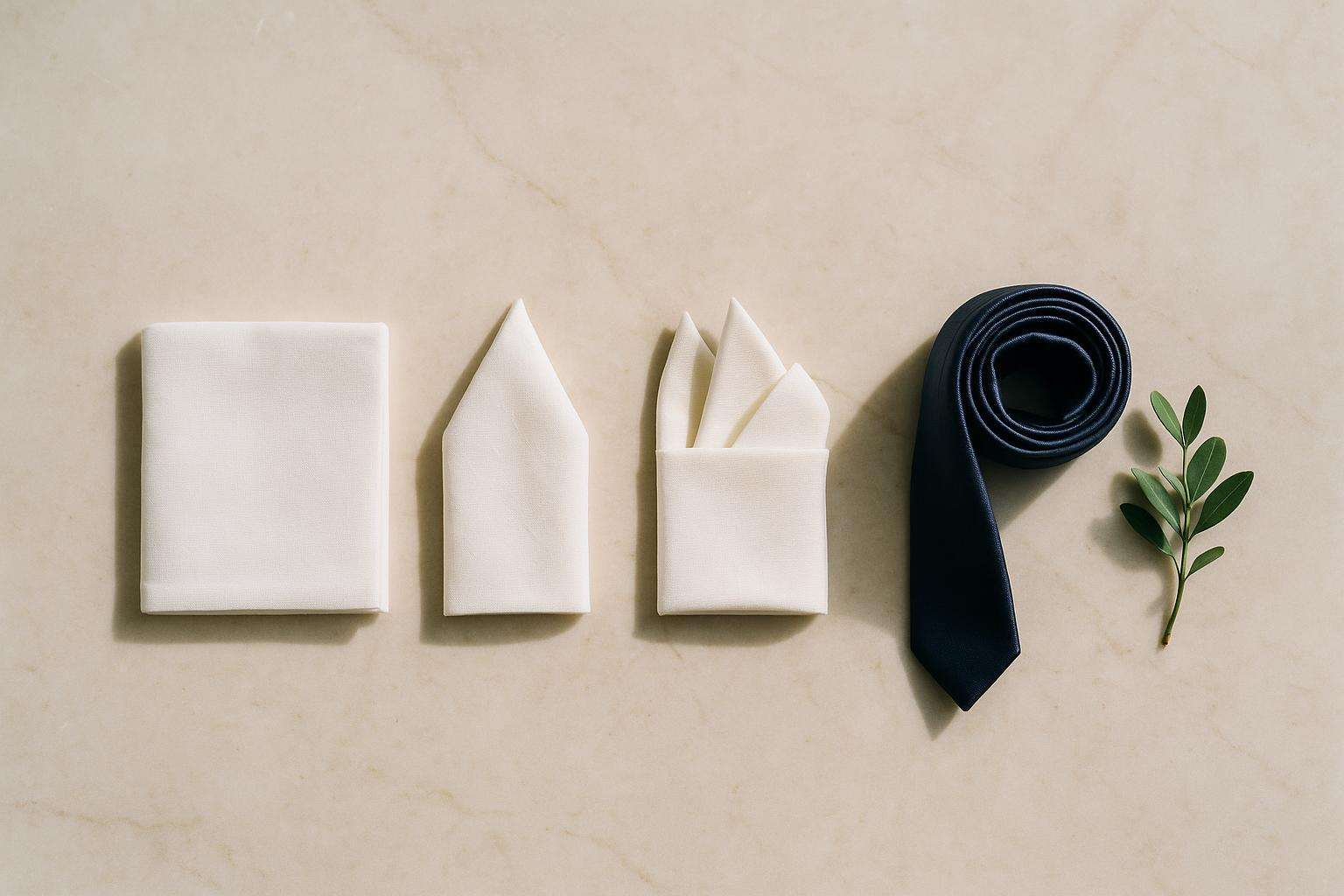
His pocket square should complement his tie — picking up a secondary colour, or going a shade lighter or darker — and never match it exactly. An identical square and tie reads like a pre-packaged gift set; coordination always looks more considered than a clone. After that, the choices are simple: a structured fold for the most formal moments, a soft puff for ease, linen when you need a crisp edge, silk when you want a relaxed bloom.
The pocket square is the smallest decision he will make about what he wears, and the one that shows most clearly in the photographs — that little flag of fabric sits at the exact height of his face in every portrait. It is worth getting right, and it is genuinely easy to get right once you know the three things that matter: the fold, the fabric, and the colour. This is a guide you can hand him, or quietly use yourself when you are the one coordinating his look against the rest of the day.
What are the best pocket square folds for a wedding?
Four folds cover essentially every wedding, and they sit on a simple scale from most formal and structured to softest and most relaxed.
The Presidential fold — also called the flat or square fold — is the most conservative and most formal of all. It shows only a clean horizontal line of fabric about a quarter-inch above the pocket. It is the default for black-tie and the most traditional ceremonies, and it is the natural home of the white linen square. Charles Tyrwhitt treats it as the formal benchmark.
The one-point fold — a single peak rising above the pocket — is the all-rounder. The Knot calls it the most versatile, one-size-fits-all option, because it works in any fabric and across formal to casual. The two-point (twin-peak) fold shows two staggered peaks; it reads slightly more structured and business-like than the single point, and it is a strong choice when he wants more presence than a flat fold but more polish than a puff. The puff fold is the softest of all — the square is pinched in the centre, pulled through the hand, and set into the pocket as a gentle scalloped dome. It is the most forgiving fold and the most relaxed.
Silk or linen — which pocket square fabric should the groom choose?
Fabric is not a detail you can ignore, because it decides which folds will actually hold their shape.
Linen is stiff enough to hold a sharp edge or a crisp peak, which makes it the correct fabric for the Presidential, one-point, and two-point structured folds. Its matte surface sits beautifully against a silk tie. A white linen square is the single most useful thing in a man's accessory drawer — Gentleman's Gazette calls it the piece that works with a tuxedo, a wedding, an interview, and a funeral alike. Cotton behaves much the same way and is the friendlier-priced version of that crisp effect.
Silk, by contrast, has soft edges and cannot hold a sharp peak, so it belongs in the puff and other flowing folds. It reads luxurious and is lovely for an evening reception, though for the most formal moments it is best to avoid high-shine silk and heavy embroidery. A useful trick is to mix textures on purpose — a silk tie with a linen square, or a wool tie with a cotton square — which gives the whole look an intentional, layered quality rather than a flat one.
| Fold | Formality | Best fabric | When it suits him |
|---|---|---|---|
| Presidential (flat) | Most formal | White linen or cotton | Black-tie, the most traditional ceremonies |
| Two-point (twin peak) | Formal | Linen or cotton | Formal weddings; more presence than a flat fold |
| One-point (single peak) | Versatile | Any — linen, cotton, silk | The safe all-rounder for almost any wedding |
| Puff | Relaxed | Silk or silk-wool | Daytime, garden, and reception ease |
Should a groom's pocket square match his tie?
No — and this is the rule the whole thing turns on. Matching the square to the tie in the same colour or pattern produces what stylists call the gift-set look: it reads cheap and pre-packaged, and it is widely named the cardinal sin of pocket-square styling. The better approach is to complement the tie — pick up a secondary colour from it, or choose a shade lighter or darker of the same hue, so a burgundy tie pairs with a soft pink square. The alternative is to contrast: a clearly different tone, with the navy tie and crisp white square being the canonical example and the white square the universal safe answer.
If both the tie and the square carry a pattern, keep their scale different — two patterns of a similar size will clash, whereas a large tie pattern with a small or solid square reads as deliberate. Gentleman's Gazette lays this out plainly: coordination beats matching every time.
How should he coordinate the square with the rest of his look?
The square does not exist in isolation. Coordinate it against the whole picture — the boutonnière, the tie, and the wider wedding palette you have already chosen — rather than only the tie. A practical and elegant move is to let him carry one crisp white linen square in a flat or two-point fold for the ceremony and photographs, then ease into a softer silk puff for the reception. Whatever he chooses, press the square first: structured folds need a hard, flat surface and a sharp crease, and you want roughly a quarter- to a half-inch of fabric showing above the pocket. Done well, it is a quiet finishing touch that makes the rest of his tailoring look considered.
Frequently asked
What is the most formal pocket square fold for a wedding?
The Presidential fold — also called the flat or square fold — is the most formal. It shows only a clean horizontal edge of fabric about a quarter-inch above the breast pocket, with no peaks at all. It is the traditional choice for black-tie weddings and the most formal ceremonies, and it pairs best with a crisp white linen square, which holds the straight edge. If he wants a touch more presence while staying formal, the two-point (twin-peak) fold is the next step up. As Charles Tyrwhitt notes, the flat fold is the formal benchmark.
Should his pocket square match his tie exactly?
No. Matching the square to the tie in the same colour or pattern creates a pre-packaged "gift-set" look that reads cheap, and it is widely considered the cardinal sin of pocket-square styling. Instead, complement the tie by picking up a secondary colour from it or choosing a shade lighter or darker of the same hue, or contrast it with a clearly different tone — a navy tie with a crisp white square is the classic. As Gentleman's Gazette puts it, coordination beats matching every time.
Should the groom choose silk or linen?
It depends on the fold. Linen is stiff enough to hold a sharp edge or peak, so it is right for the structured Presidential, one-point, and two-point folds, and a white linen square is the most versatile piece he can own. Silk has soft edges and cannot hold a sharp peak, so it belongs in the soft puff fold; it reads luxurious and suits an evening reception, though high-shine silk is best avoided at the most formal moments. Cotton behaves like linen at a friendlier price. Mixing textures — a silk tie with a linen square — looks intentional rather than flat.
What is the easiest pocket square fold to do?
The puff fold is the most forgiving and the quickest. Pinch the square in the centre, lift it, pull it through your other hand until it is about three-quarters of the way down, fold the loose points under, and set it softly into the pocket as a scalloped dome. It works in silk and silk-wool and suits relaxed daytime and reception looks. If he wants something a little more structured but still simple, the one-point (single peak) fold is the versatile all-rounder that works in any fabric across almost any wedding.
What colour pocket square works with any suit?
White. A white linen pocket square is the universal safe choice — it works with a tuxedo, a navy or charcoal suit, a wedding, even an interview or a funeral. Because it is a neutral contrast piece, it never clashes with the tie and never reads as a matched set. Gentleman's Gazette calls it the staple every man should own. If you want a little more personality, choose a coloured square that picks up a secondary tone from the tie or the wider wedding palette, rather than matching the tie directly.
How much of the pocket square should show?
For structured folds such as the Presidential, one-point, or two-point, show roughly a quarter- to a half-inch of fabric above the edge of the breast pocket — enough to register in a photograph without dominating the jacket. Press the square first and fold it on a hard, flat surface so the crease is crisp. For a soft puff, the height is less precise; you simply want a gentle, even bloom rather than a deflated wad of fabric. Either way, aim for a finished, deliberate line rather than something stuffed in at the last minute.