Groomsmen
How Many Groomsmen Can You Have? (Rules & Etiquette)
There is no fixed number — most weddings land at four to six. Here is how to scale his side to your guest count, venue, and formality, and why uneven sides never actually look wrong.
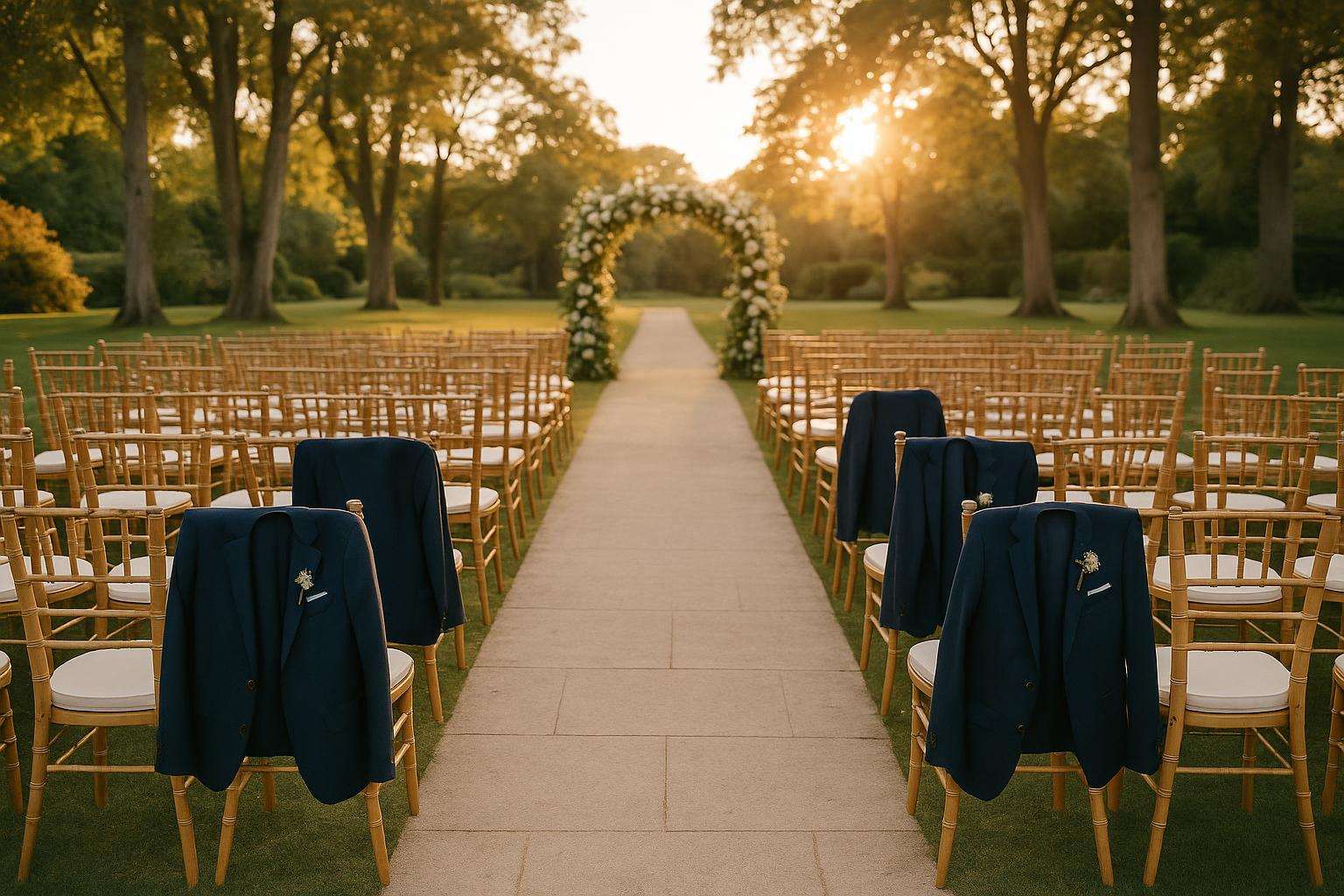
Aim for four to six groomsmen for most weddings, scaled by the rule of thumb of about one per fifty guests and adjusted for your venue and formality. Don't force the count to match the bridesmaids — uneven sides are normal, and the processional, the altar lineup, and the portraits all have clean fixes that make any number read as intentional.
It is one of the first questions that comes up once the planning is underway, and it tends to carry more quiet anxiety than it deserves: how many men should stand at his side? The honest answer is that there is no fixed number. The modern average is a comfortable band rather than a rule, and the count that suits your wedding depends on your guest list, your venue, and the tone of the day far more than on any tradition. What follows is how to settle on the right figure — and why the thing most couples worry about, an uneven split with the bridesmaids, almost never looks the way they fear.
What is the average number of groomsmen at a wedding?
The most-cited modern average is four to five, with five the single most common figure. Generation Tux puts the average at five and treats two to ten as the normal range, while The Knot's wedding-party data lands the typical celebration at around four to five attendants per side. Older etiquette suggested a tighter three to five; the contemporary sweet spot most editors now name is four to six groomsmen, producing a wedding party of roughly eight to twelve people — ten to fourteen once you count the couple. That band is large enough to feel celebratory in the photographs and warm at the altar, yet small enough to keep attire, gifts, getting-ready space, and the logistics of the morning calm.
There is also a planning heuristic worth knowing: roughly one groomsman, and one bridesmaid, per fifty guests. As David's Bridal frames it, this is a starting point rather than a law. Its value is simple proportion: it keeps the party scaled to the room, so a handful of attendants don't look lost at a 250-guest ballroom and a dozen don't crowd a 40-guest garden ceremony.
How many groomsmen should you have for your wedding size and venue?
The cleanest way to choose is to scale the count to the guest list, the venue, and the formality together. Drawing on the guidance from David's Bridal and Generation Tux, the tiers look like this:
| Wedding size | Typical guest count | Groomsmen (his side) | Notes |
|---|---|---|---|
| Intimate / micro | Under ~50 | 1–3 | A single best man is plenty at an elopement or micro-wedding. |
| Mid-size | 50–100 | Up to ~5 | Four to five fills the altar gracefully without crowding. |
| Large | 100–200 | 5–8 | A fuller party reads as proportionate in a big room. |
| Very large / ultra-formal | 200+ | 6–10 | Even ten looks balanced at this scale and formality. |
Venue geometry matters as much as the guest count. A long cathedral aisle and a wide altar platform carry a big party gracefully, while a tight chapel, a vineyard arbor, or a rooftop terrace can feel crowded with eight men on one side. Formality pulls the number upward: a black-tie wedding suits a fuller party than a casual backyard celebration, where one or two attendants is entirely appropriate. Picture the party standing in your actual ceremony space before you settle on a figure — the room will often answer the question for you.
Do groomsmen and bridesmaids have to be even?
No — and this is the worry most worth setting down. Every major outlet now treats uneven sides as completely normal and widely accepted. The Knot advises choosing the people who genuinely matter to each of you, then making the presentation even rather than the headcount. Generation Tux is candid about why you shouldn't force the match: padding the party with someone purely to balance a number can leave that person feeling like a placeholder, which is a poor reason to hand out a role this meaningful.
So if he has three brothers he can't imagine standing without and you have five close friends you'd never cut, let the sides be five and four. The difference will not read as a mistake to anyone in the room. What follows is how a planner and a photographer make any split look entirely intentional.
How do you make an uneven wedding party look balanced?
This is the real question hiding behind the count, and it is fully solvable. The standard toolkit, as laid out by The Knot and Inside Weddings, works at every stage of the day:
- In the processional: the extra attendant can walk solo — often a lovely, deliberate moment — or one person escorts two, such as a groomsman with two bridesmaids, or a bridesmaid flanked by two groomsmen. You can also have everyone walk in individually, so pairing never enters the picture, or seat the party from the start and skip the processional entirely.
- At the altar: with normal spacing, a one-person difference is rarely noticeable. If you'd rather erase it completely, arrange the party in a semicircle of alternating people surrounding the couple rather than in two rigid rows — the asymmetry simply dissolves.
- In the portraits: the fix is composition. When the couple angles slightly inward toward the maid of honor and best man, the lineup becomes symmetrical around the couple rather than the camera. Mixing where attendants stand — rather than the rigid all-bridesmaids-left, all-groomsmen-right block — distributes the numbers evenly across the frame. Any competent wedding photographer has poses ready for exactly this.
- At the reception: introduce the wedding party at the head table before the toasts rather than announcing each attendant in a grand entrance, and the uneven count never registers with guests at all.
An odd number ruins nothing. The asymmetry you're picturing exists mostly in the planning spreadsheet, not in the photographs.
When should you lock in the number of groomsmen?
Practically, settle the count before he asks anyone. Issuing an invitation to stand and then taking it back is one of the few genuinely hurtful wedding-party missteps, so the size should be decided first and held firm. Choose it together as a couple, loosely coordinating the two sides without forcing a match, then confirm your venue and final guest count before any invitations go out.
It helps to remember what each name on the list carries downstream. Every groomsman means another suit or tuxedo to coordinate, another gift, another seat at the getting-ready breakfast, a larger bachelor party to plan, and one more boutonniere on the order. None of that is a reason to be stingy with the people who matter — it is simply why the four-to-six band remains the quiet favorite. Choose the men who belong at his side, scale the figure to your day, and trust that the room and the photographs will make it look exactly right.
Frequently asked
What is the average number of groomsmen at a wedding?
The most commonly cited modern average is four to five, with five the single most frequent figure. Generation Tux puts the average at five, treating two to ten as the normal range, and The Knot's wedding-party data lands at roughly four to five attendants per side. The contemporary sweet spot most editors name is four to six groomsmen, which produces a wedding party of about eight to twelve people once you count both sides. That band is large enough to feel celebratory in the photographs and at the altar, yet small enough to keep attire, gifts, getting-ready space, and the bachelor party from sprawling out of hand.
How many groomsmen should you have for 100 guests?
A widely repeated planning heuristic is roughly one groomsman per fifty guests, so a hundred-guest wedding suggests about two as a baseline — though most couples at that size comfortably run four to five to fill the altar gracefully. David's Bridal frames the rule as a starting point rather than a law: it simply keeps the party proportional to the room, so a handful of attendants don't look lost in a large ballroom and a dozen don't crowd an intimate space. For one hundred guests, anywhere from four to six groomsmen reads as balanced and intentional.
Do groomsmen and bridesmaids have to be even?
No. Every major wedding outlet now treats uneven sides as completely normal and widely accepted. The Knot advises choosing the people who genuinely matter to each of you, then making the presentation even rather than forcing the headcount to match. Generation Tux is blunt about why padding the party is a poor idea: handing someone a meaningful role purely to balance a count can feel like being used as a placeholder. A one-person difference is rarely noticeable at the altar with normal spacing, and a good photographer composes around it easily — so let the numbers be what they are.
How do you make an uneven wedding party look balanced?
The fix is presentation, not headcount. In the processional, the extra attendant can walk solo, or one person can escort two — a groomsman with two bridesmaids reads as charming and considered. At the altar, arrange the party in a semicircle around the couple rather than two rigid rows, which dissolves the asymmetry entirely. In the portraits, angling the couple slightly inward toward the maid of honor and best man makes the lineup symmetrical around the couple rather than the camera. Inside Weddings notes that introducing the party at the head table before toasts also keeps the count from ever registering with guests.
Can you have just one groomsman or only a best man?
Absolutely. At an elopement, a micro-wedding, or any celebration under roughly fifty guests, a single best man is entirely appropriate and often the most graceful choice. A lone attendant at his side reads as deliberate and intimate, not sparse, and it sidesteps the cost and coordination that each additional groomsman carries. If your partner is keeping her side small too, one attendant each keeps the proportions clean. The number should follow the scale and tone of your day rather than any obligation to fill a row, and a party of one on each side photographs beautifully at a small venue.
When should you decide how many groomsmen to have?
Lock in the number before he asks anyone. Issuing an invitation to stand and then rescinding it is one of the few genuinely hurtful wedding-party missteps, so the count should be settled first. Decide the size together as a couple, loosely coordinating the two sides without forcing a match, then confirm your venue and guest count before extending any invitations. Keep in mind that every addition scales the downstream commitments — attire, groomsmen gifts, the bachelor party, getting-ready space, and boutonnieres all grow with the number, which is part of why the four-to-six band stays so popular.