Wedding Bands
Matching His Band to Her Ring Without Being Matchy
How his wedding band should relate to your engagement ring — match the metal, echo the finish, or contrast on purpose, and whether to buy the two as a set.
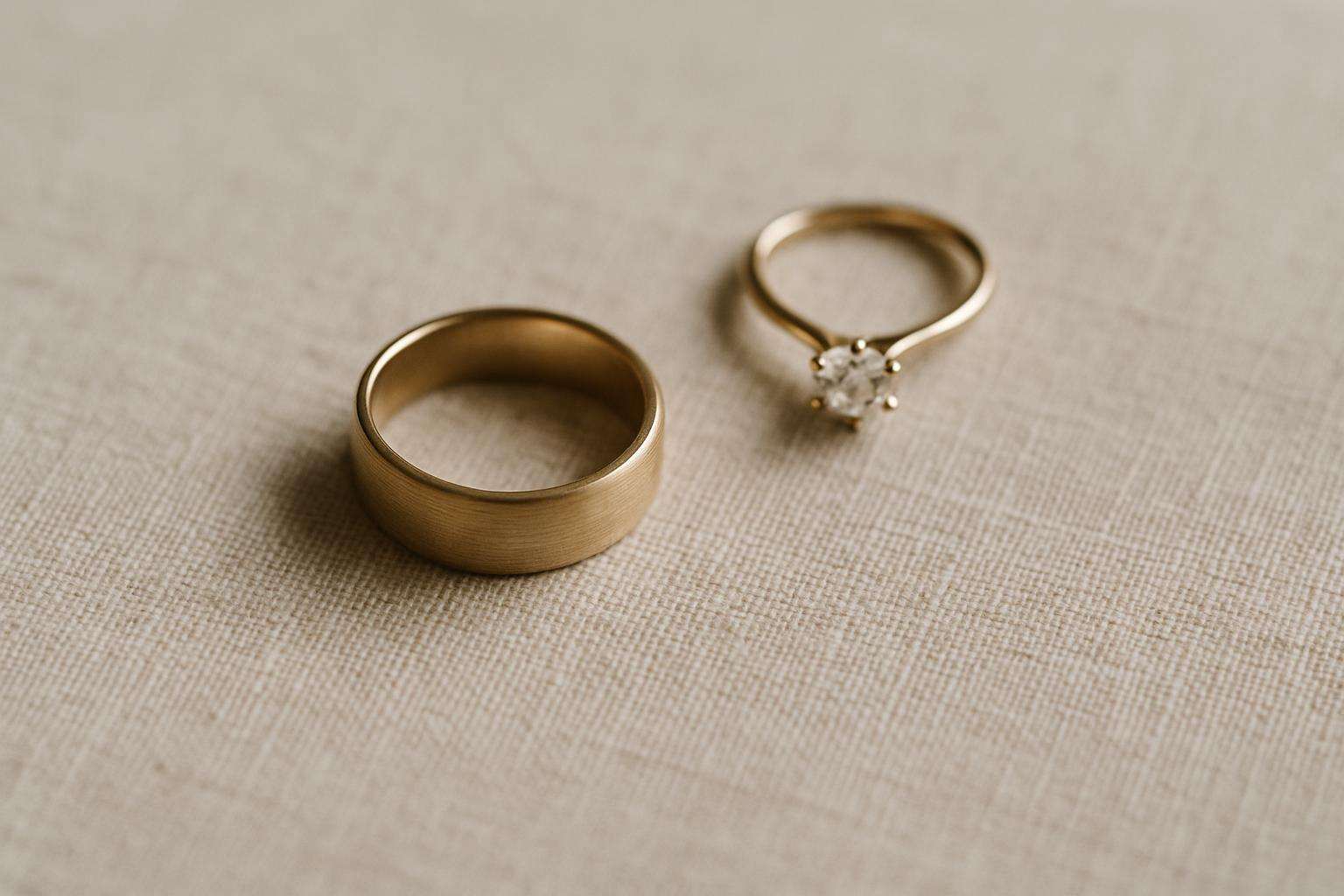
His band does not have to match your engagement ring — and historically never did. Treat coordination as three smaller decisions: how closely his metal tracks yours (match, complement, or contrast), whether the finishes echo, and whether you buy the two rings as a set or separately. The one genuine technical caveat — metal hardness — affects whichever ring is softer, not his band.
Somewhere between choosing your dress and finalizing the seating chart, a small question surfaces: does his wedding band have to match your engagement ring? It feels like it should have a rule. It does not. The "matching set" you picture is a retail convention barely older than your grandparents, and once you see it that way, the decision gets a great deal easier — and more personal.
Do his wedding band and your engagement ring need to match?
No. There is no tradition requiring it, and the expectation is more recent than most people assume. Men only began wearing wedding rings widely in the United States during and just after the Second World War; by the late 1940s roughly 80% of American weddings included an exchange of bands, and jewelers began selling coordinated sets in the same metal and finish largely because it made shopping simpler, as Blue Nile recounts. "Should they match" is therefore a style choice, not an obligation.
It helps to name the three honest options, because all three are correct:
- Match — the same metal family and a similar finish. The safe classic.
- Complement — the same metal color, but a different texture or width, so the rings read as a pair without being identical.
- Contrast — a deliberately different metal or color on his hand, treated as its own piece.
Here is the freeing part: his band sits on his hand and your engagement ring on yours. The two are never physically next to each other, so the metal "clash" that worries brides stacking their own rings is, for the two of you, mostly theoretical.
How do you match his metal to your engagement ring?
Start from your engagement-ring metal and decide how closely his should track it — and if you are unsure whether a flat or contoured band will sit flush against her engagement ring setting style, that is worth confirming before you order. Jewelers like Long's and Tacori frame this as contrast levels. A yellow-gold band beside a yellow-gold engagement ring is low contrast and harmonious; a white-gold or platinum band against a yellow- or rose-gold ring is high contrast and clearly intentional; a rose-gold band against a yellow ring sits gently in between.
The one genuinely technical caveat is hardness, and it lands on whichever ring is softer. Gold sits around 2.5 to 3 on common hardness references while platinum is closer to 3.5, so a harder ring worn against a softer one will tend to mark the softer metal over time, per Long's Jewelers. Again, because his ring and yours are on separate hands, this matters far less than it would for a single stacked hand — but it is worth knowing. The table below is a quick way to read his options against your ring.
| If your ring is… | Low-contrast match | Intentional contrast | Note for his hand |
|---|---|---|---|
| Yellow gold | Yellow-gold band | White gold, platinum, or grey alternative metal | Rose gold is an easy warm half-step |
| White gold / platinum | White-gold or platinum band | Yellow or rose gold | Tungsten/titanium read as a cooler grey, not a true match |
| Rose gold | Rose-gold band | White metal or grey alternative | Yellow gold keeps the warmth with light contrast |
| Platinum (and active hands) | Platinum band | — | Similar hardness keeps both rings unscratched |
His band also opens up a much wider field than your engagement ring ever would. Brilliant Earth offers men's bands in platinum, 14K and 18K gold, tungsten, titanium, tantalum, cobalt, and meteorite, and recommends durable metals like tungsten, titanium, or platinum if he works with his hands. One maintenance note worth passing along: white gold's rhodium plating wears down and benefits from re-plating every couple of years, which a tungsten or platinum band avoids entirely.
Should you buy his and hers as a set or separately?
Buying as a set is the surest way to align metals and finishes without guesswork. Blue Nile draws a useful distinction between a wedding set — your engagement ring plus coordinating bands for both partners — and a bridal set, which covers only your rings; buying together keeps the metals, finishes, and details matching cleanly. Plain men's bands at Blue Nile start around $280, with diamond styles climbing into the thousands depending on stones and width. Brilliant Earth takes a slightly different path: you select your engagement ring first, and the site then surfaces coordinating bands in matching widths and finishes — handy when you want his ring to echo yours without designing from a blank page.
Buying separately is just as valid, and often the smarter move. If his lifestyle calls for tungsten or titanium, or he simply prefers a different look, his ring has no obligation to come from the same collection as yours. The middle path most couples land on is to share one small thing — the metal color, the finish, or a hidden engraving inside both bands — rather than the whole design. That single shared detail is what makes two different rings still feel like a matched pair, which is the whole point of doing this well.
What does "matched but not matchy" actually look like?
The finish is where you control the matchy dial. Hold the metal color constant — say, both rings in white gold — but give his band a brushed or matte texture against your polished engagement ring, and the pair reads as coordinated without looking like twins. That contrast in texture is doing quiet, intentional work. Most jewelers, Brilliant Earth included, offer the same band in polished, brushed, matte, and hammered finishes precisely so you can keep the color and vary the texture. Echo one detail rather than copying everything, and the two rings will look like they were chosen for each other — because they were.
Frequently asked
Does his wedding band have to match my engagement ring?
No. There is no rule that his band must match your engagement ring, and the expectation is more recent than most people assume. Coordinated "sets" became popular in the United States only after men began widely wearing wedding rings in the 1940s, when jewelers started selling matching bands largely to simplify shopping, per Blue Nile. You have three good options: match the metal and finish for a classic look, complement it with the same color but a different texture, or contrast it on purpose. Because his band sits on a different hand from your engagement ring, the two are never physically adjacent, so a metal "clash" is largely theoretical.
Can his band be a different metal than my engagement ring?
Yes, and it often should be. His hand and his daily wear may call for something your engagement ring would never use. Brilliant Earth offers men's bands in platinum, 14K and 18K gold, tungsten, titanium, tantalum, cobalt, and meteorite, and recommends durable metals like tungsten, titanium, or platinum for active hands. A different metal on his finger reads as an intentional choice rather than a mistake, especially when you keep one shared element — the metal color, a finish, or a hidden engraving — so the two rings still feel like a pair.
Will a platinum band scratch a gold engagement ring?
It can, but the risk falls on whichever ring is softer rather than on his band. Gold sits around 2.5 to 3 on common hardness references while platinum is closer to 3.5, so a harder ring worn beside a softer one will tend to mark the softer metal over time, as Long's Jewelers notes. Because his band and your engagement ring are on separate hands, they are not constantly rubbing together, so this matters less for the two of you than it would for a bride stacking her own band against her engagement ring. If you want both rings to stay pristine, choose metals of similar hardness.
Should we buy his and hers rings as a set?
Buying as a set is the surest way to align the metals and finishes without guesswork. Blue Nile distinguishes a wedding set — your engagement ring plus coordinating bands for both partners — from a bridal set, which covers only your rings, and notes that buying together keeps the details matching cleanly. Brilliant Earth lets you select your engagement ring first and then surfaces coordinating bands in matching widths and finishes. Buying separately is equally valid, and usually better when his lifestyle calls for a metal your ring would not use.
Does the finish need to match, not just the metal?
The finish is where you control how matchy the pairing reads. Two rings in the same metal color but different textures — say a high-polish engagement ring and a lightly brushed or matte men's band — feel coordinated without looking like an identical pair, which is exactly the "matched but not matchy" effect most couples are after. Brilliant Earth and most jewelers offer the same band in polished, brushed, matte, and hammered finishes, so you can hold the metal color constant and let texture do the differentiating. Echoing one detail, rather than copying everything, almost always looks more intentional.
What if my engagement ring is rose gold?
Rose gold gives you a warm anchor and plenty of flattering directions for his band. A rose-gold men's band reads as a soft, low-contrast match; a yellow-gold band stays warm but adds a little contrast; and a white metal — white gold, platinum, or a grey alternative metal like titanium or tantalum — gives a deliberate high-contrast look. Per Tacori, mixing gold colors is one of the easiest pairings to pull off because warm tones sit comfortably together. Choose the contrast level that suits his taste, then keep a shared finish or engraving to tie the two rings back to each other.