Wedding Bands
Men's Gold Wedding Bands: Yellow, White & Rose Compared
Yellow, white, or rose — and 14k or 18k? A clear, traditional comparison of the groom's gold band: durability, upkeep, who each suits, and real prices.
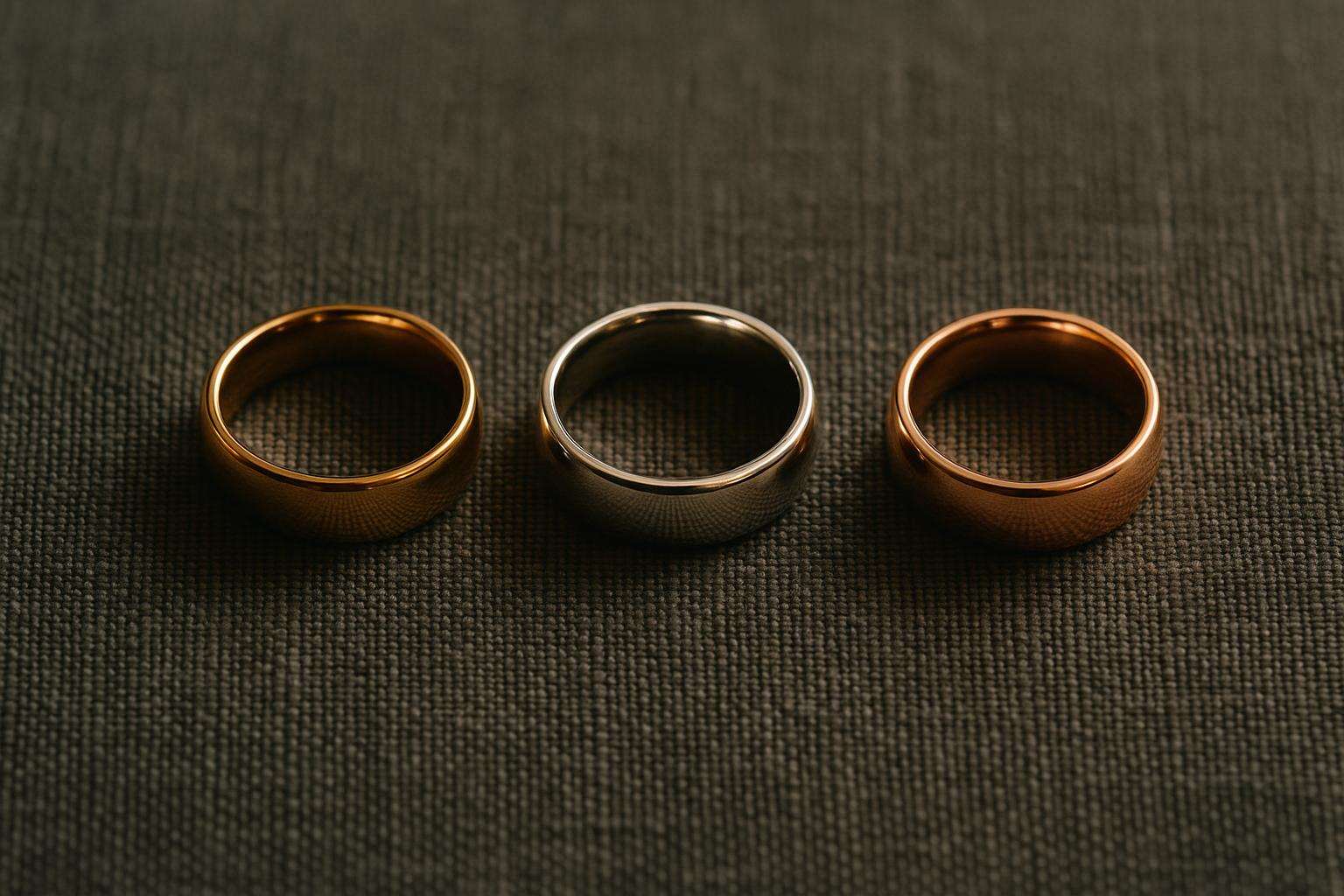
For a band you will wear every day, 14k gold is the practical choice over 18k — it is markedly harder, holds a polish longer, and costs less, while looking nearly identical to the eye. On color, yellow is the lowest-maintenance and most traditional, white gives a platinum look but needs rhodium replating every year or two, and rose is warm, durable, and usually the best value. Reach for 18k only for richer color, an heirloom match, or sensitive skin.
Gold has carried wedding meaning for centuries, and it remains the most-purchased metal for a groom's band — warm against the skin, easy for any jeweler to resize and engrave, and, unlike tungsten or ceramic, repairable rather than disposable if it ever needs to come off in a hurry. But "a gold band" is really two decisions in one: the color (yellow, white, or rose) and the karat (almost always 14k or 18k). Get both right and the ring still looks right in the photographs decades on.
What is the difference between 14k and 18k gold for a wedding band?
Karat measures purity. 14k is 58.3% pure gold; 18k is 75% pure gold, with the balance made up of alloy metals — copper, silver, zinc, palladium — that add strength and shape the color. Because pure gold is soft, that higher alloy content is exactly what makes 14k the tougher everyday metal.
The numbers are clear. On the Mohs hardness scale, 14k sits around 3.5–4 versus 2.5–3 for 18k, and independent testing cited by jewelers shows 14k withstands roughly 43% more force before denting than 18k. It also holds a polish noticeably longer — about six to twelve months against three to six for 18k. And it costs less: 18k typically runs 30–50% more than a comparable 14k band.
So why ever choose 18k? Color depth and feel. The extra gold gives 18k a richer, deeper hue and a slightly more luxurious heft, and because there is less alloy it is gentler on skin prone to nickel sensitivity. For a groom who works with his hands, 14k is the sound default; for one matching an heirloom or wanting that warmer glow, 18k earns its premium.
Yellow vs white vs rose: how do the three gold colors compare?
The three colors are all gold — what changes is the alloy mixed in, and with it the look, the hardness, and the upkeep.
Yellow gold is the purest color and the lowest-maintenance of the three. It resists tarnish and corrosion, takes engraving beautifully, and never needs replating. Its one weakness is softness: of the three colors it is the most likely to dent or scratch, which is why 14k yellow is the comfortable sweet spot for daily wear.
White gold is yellow gold alloyed with white metals and then plated in rhodium to achieve its bright, platinum-like finish. That plating wears with daily use, so a man's white-gold band generally needs rhodium replating every twelve to twenty-four months, at roughly $30–$100 a visit and sometimes covered by a jeweler's warranty. White gold's alloy makes it harder than yellow, but the maintenance is the trade. Grooms who never want to think about upkeep often choose platinum instead.
Rose gold gets its blush from copper, and copper is a strong metal — so rose wears well and, like yellow, needs no plating. The karat changes the tone: 14k rose reads rosier (more copper), while 18k rose is a softer, more golden blush (more gold). It is frequently the most affordable of the three colors and stays warm and distinctive with very little fuss.
| Color | Maintenance | Relative durability | Best for |
|---|---|---|---|
| Yellow | Lowest — no plating | Softest of the three | The traditionalist; easiest to service anywhere |
| White | Rhodium replate ~every 1–2 yrs | Harder alloy; plating wears | A platinum look without the platinum price |
| Rose | Low — no plating | Hard (copper) | Warmth, character, and value |
What do men's gold wedding bands actually cost?
Men's bands average around $500 but range from roughly $90 to $3,000-plus, driven by metal, karat, width, finish, and any diamonds. Here is what the major online jewelers list as of mid-2026.
At Blue Nile, a 5mm comfort-fit band runs about $750 in 14k white gold and $1,090 in 18k yellow gold — a vivid illustration of how much both karat and width move the price. At James Allen, classic men's gold bands span roughly $250 to $1,000-plus; a near-identical pair shows the karat premium plainly, with 14k yellow around $540 against $840 for the 18k version, and 14k white near $790 versus $1,320 in 18k. Brilliant Earth works in recycled and Fairmined gold, with a 6mm band around $1,090 in 18k yellow and $750 in 14k white.
Two practical levers keep the cost sensible: choose 14k over 18k where you can, and choose a width you will actually wear — a 6mm band uses noticeably more gold than a 4mm. The right band is the one that suits his hand and his days, not the heaviest one in the case.
So which gold band should the groom choose?
If he wants the simplest, most traditional ring, choose 14k yellow gold: classic, low-maintenance, and serviceable by any jeweler for life. If he loves the cool, modern look of platinum but not its price, 14k white gold delivers it, with a small replating ritual every year or two. If he wants something warm and a little distinctive that still wears hard, 14k rose gold is the value-savvy pick. Step up to 18k in any color only when richer hue, a family match, or sensitive skin makes it worth the premium — and the gentler care that comes with it.
Frequently asked
Is 14k or 18k gold better for a men's wedding band?
For everyday wear, 14k is usually the better choice. It is 58.3% pure gold with more strengthening alloy, which makes it harder (Mohs 3.5–4 versus 2.5–3 for 18k), more scratch- and dent-resistant, and longer-lasting between polishes. It also costs roughly 30–50% less than comparable 18k. Choose 18k only if you want a richer gold color, are matching an heirloom, or have nickel-sensitive skin that does better with the higher gold content.
Which gold color needs the least maintenance?
Yellow gold is the lowest-maintenance. It never needs plating, resists tarnish and corrosion, and is simple for any jeweler to clean, engrave, or resize. Rose gold is also low-maintenance, since its copper alloy is hard and requires no plating. White gold needs the most care because its bright finish comes from rhodium plating that wears off with daily use and must be replated roughly every one to two years. If a groom dislikes upkeep, yellow or rose gold is the easier road.
How often does a white gold wedding band need rhodium replating?
A men's white gold band worn every day typically needs rhodium replating every 12 to 24 months, depending on lifestyle, skin chemistry, and how thickly it was originally plated. Signs it is due include a dull look or a faint yellow tint showing through where the rhodium has worn. The service is quick and inexpensive — usually about $30 to $100 per visit, and sometimes covered by a jeweler's warranty. Grooms who want a permanent white finish with no replating often consider platinum instead.
How much does a men's gold wedding band cost?
Men's wedding bands average around $500 but range from about $90 to $3,000 or more, depending on color, karat, width, finish, and any diamonds. At the major online jewelers, expect roughly $540 for a 14k yellow band and around $840 for the same in 18k at James Allen; about $750 for a 14k white band at Blue Nile; and near $1,090 for an 18k yellow band at Brilliant Earth. Width and karat are the biggest price levers.
Is rose gold a good choice for a men's wedding band?
Yes — rose gold is a strong, often underrated option for a groom. Its blush comes from copper, a hard metal, so rose gold wears well and, unlike white gold, needs no plating. It is frequently the most affordable of the three gold colors and reads as warm and distinctive without being flashy. A 14k rose band looks rosier (more copper), while 18k rose is a softer, more golden blush. It suits a groom who wants a little character in a ring that still holds up to daily life.
Does white gold or yellow gold scratch more easily?
Yellow gold scratches more easily than white gold. White gold is alloyed with harder white metals, which gives it more scratch resistance than yellow of the same karat. That said, within either color, 14k resists scratches and dents better than 18k because it contains more strengthening alloy and less soft pure gold. So the most scratch-resistant common gold band is 14k white, while 18k yellow is the softest of the everyday options — a useful thing to weigh for a groom who is hard on his hands.