Wedding Bands
Men's Band Styles, Widths & Finishes: Matte, Hammered, Beveled Explained
Width sets presence, profile sets comfort, finish sets personality. A plain-language guide to the three style decisions behind his ring — and how each one photographs and wears.
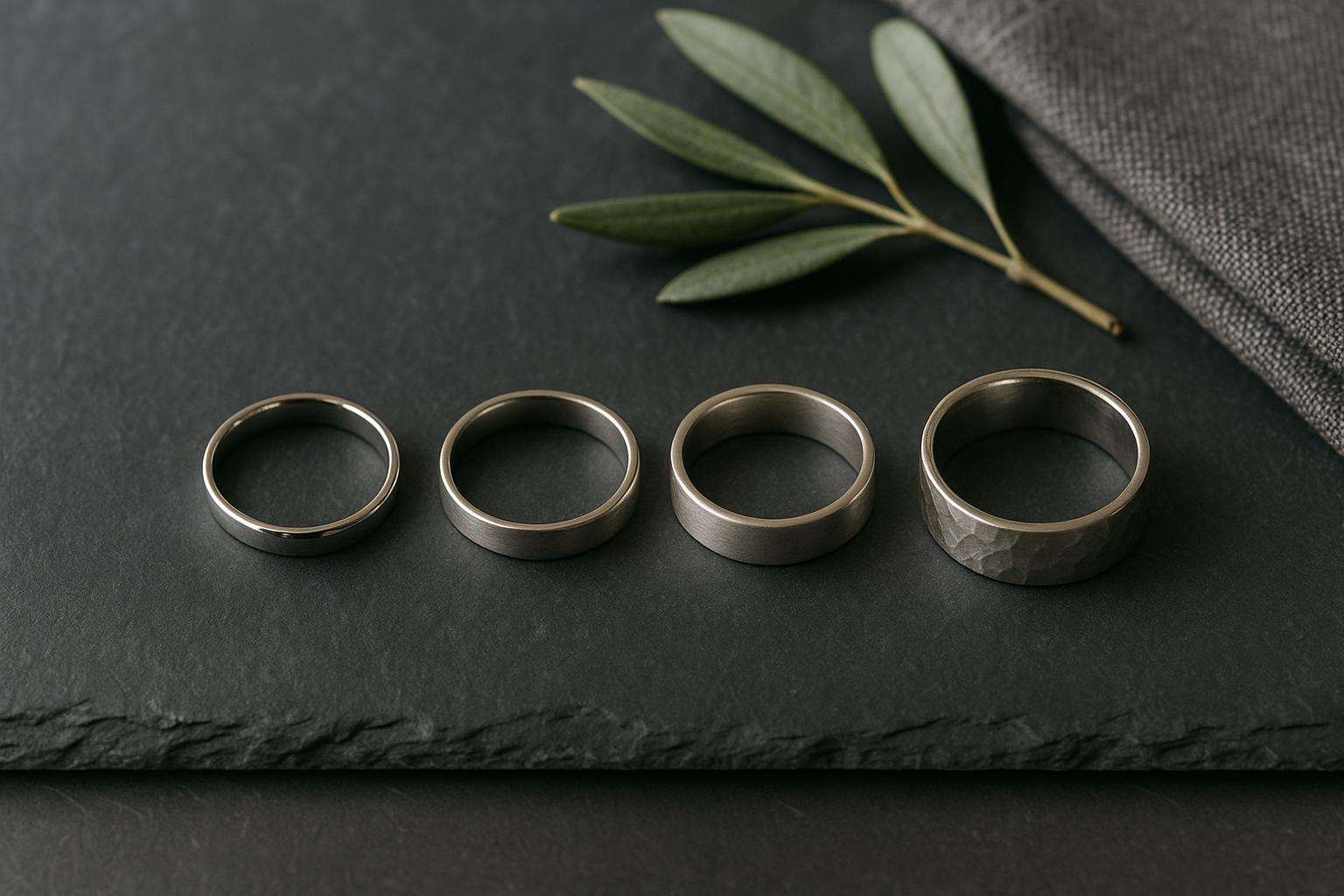
Choosing his wedding band is really three small decisions, not one. Width sets how much presence the ring has and is matched to his hand size. Profile — the shape of the cross-section — sets comfort and how the edge catches light. Finish sets personality and decides how the ring photographs and ages. Settle those three for the look, and choose the metal separately for its properties.
When the metal question gets all the attention — tungsten or titanium, gold or platinum — it is easy to forget that the metal is only the material. The thing that actually makes one band look reserved and another look bold, one feel like nothing on the finger and another announce itself, is a trio of style choices that have little to do with the metal at all. If you are helping him choose, learning this small vocabulary makes every showroom conversation faster and far less daunting. Here is how to read width, profile, and finish — and how each one behaves in real life and in the photographs you will keep.
How wide should a men's wedding band be?
Width is measured in millimeters across the face of the band, and it is the single biggest lever on a ring's presence. Most men's bands sit between 4mm and 10mm, with 6mm and 8mm the two most chosen widths. A narrow 2–4mm band reads understated and minimalist; a 5–6mm band is the versatile middle that most jewelers, including Jewelry by Johan, recommend as a starting point. An 8mm band carries more weight and statement, and 10mm and up is a maximum-presence choice.
The proportion to keep in mind is simple: wider bands flatter larger hands and longer fingers; narrower bands flatter smaller hands. The team at With Clarity and the practical rule from Manly Bands agree on a useful shortcut for the uncertain: if his ring size is around 9 or below, keep the width near 6mm; above size 9, an 8mm band tends to sit in better proportion. Most men land happily in the 6–8mm range.
| Width | Reads as | Best for |
|---|---|---|
| 2–4mm | Understated, minimalist | Slender fingers; a man who prefers barely-there jewelry |
| 5–6mm | Balanced, classic — the versatile default | Average hands, smaller ring sizes (~9 and below), first-time ring wearers |
| 8mm | Bold, substantial | Larger hands and broader builds; room for texture or inlay |
| 10mm+ | Maximum presence | Very large hands; men used to wearing sizable rings |
One thing the showroom may not mention: width changes how the ring feels, not just how it looks. A wide 8mm band feels tighter than a 4mm band at the same ring size, because more metal contacts the finger. The standard fix is to go up about a half size for anything wider than 6mm, and to choose a comfort-fit interior for 8mm-plus bands or for a groom who has never worn a ring.
What are the band profile shapes, and which is most comfortable?
Profile is the shape of the ring's cross-section, and it is the choice that most affects all-day comfort. Manly Bands describes four common shapes. The court (or full-court, comfort-fit) profile is rounded both inside and out — the most popular and the most comfortable, gliding easily over the knuckle. The dome (D-shaped) profile is rounded on the outside and flat inside, the classic look many of us picture on our fathers' hands. A flat profile is flat inside and out for a clean, modern, slightly more angular line. A concave profile dips inward on the exterior for something more distinctive.
Comfort fit deserves a word of its own, because it is a property of the interior rather than a separate style. The inner surface is gently rounded so the metal lifts away from the finger at the edges, lowering pressure and friction across a long day. From the outside it looks identical to a standard band — the width and finish are untouched — which is why it is the quiet default on most men's rings, and the right call for wider bands and for hands that swell. Remember it runs about a half size larger, so he should subtract roughly half a size from a standard measurement.
Then there is the beveled edge, the detail in this guide's title. A beveled band has angled, chamfered edges that taper a flat top into a narrower visible face. The clever consequence is that a beveled 8mm ring reads a little less bulky than a flat 8mm ring — the top surface is narrower — while keeping the same confident footprint. The bevels also add facets that catch light, giving the band crisp, almost architectural definition.
How do matte, brushed, hammered, and polished finishes differ in look and wear?
Finish is the personality axis, and the one that most changes how a ring photographs and how it ages. A polished finish is mirror-bright and reflects light evenly — the most formal, timeless look, and gorgeous in soft light, with the honest trade-off that it shows every scratch and asks for the most upkeep. A brushed finish lays fine parallel lines across the surface for a low sheen; because new scratches blend into that grain, it hides wear beautifully and sits, as one jeweler puts it, “refined enough for a suit, rugged enough for the job site.”
A matte or satin finish is brushed's smoother cousin — a soft, even, glare-free sheen with no directional lines. It reads modern and stays low-maintenance, and it pairs especially well with darker metals like black zirconium and black titanium. Keep one quirk in mind: dark surfaces recede visually, so a 6mm black matte band looks slightly narrower than a bright 6mm band — size up to 8mm if you want it to register. A hammered finish, created by striking small irregular facets into the metal and usually softening them with a satin overlay, gives a handcrafted, light-catching look that conceals dings and is unique to every piece; wider bands show it best.
For how each wears and photographs, the guidance from Corey Egan and Mark Broumand lines up: textured finishes — brushed, matte, hammered — forgive everyday wear, while polished and faceted surfaces “look incredible on day one but ask more of you to keep them that way.” In photographs, polished sparkles in soft directional light but can blow out under flash; hammered is the most camera-friendly because its facets catch light from many angles; brushed and matte read elegant and even. Match the finish to what his hands do all day, and to how your photographer likes to light.
How is the style decision different from the metal decision?
This is the framing that makes the whole thing click. Width, profile, and finish describe the ring's style and can be applied to nearly any metal. The metal — tungsten, titanium, cobalt, gold, platinum — is a separate decision about color, weight, hardness, whether it can be resized, and price. The cleanest order is to settle the style first: choose a width that fits his hand, then a profile for comfort, then a finish for personality and wear. Only then weigh the metals, which we cover in our dedicated metals guide. The Knot's buyer guidance treats finish and width the same way — as style choices layered onto a metal you pick for its properties. Decide them in that order and you will move through any showroom, or any late-night browse together, with a clear and confident eye.
Frequently asked
Is a 6mm or 8mm wedding band better for him?
It comes down to his hand, not a trend. A 6mm band is the widely recommended starting point — substantial but never overwhelming, and the kindest width for a man who has never worn a ring or who has slender fingers or a smaller ring size (around size 9 or below). An 8mm band suits larger hands and broader builds, makes a bolder statement, and gives more room for texture or inlay. A useful jeweler's rule of thumb from Manly Bands: cap the width near 6mm for sizes 9 and under, and lean toward 8mm above that. When in doubt, have him try both on a relaxed, room-temperature hand.
What is a comfort fit band, and is it worth it?
Comfort fit refers to the inside of the ring, not the outside. The interior is gently rounded so the metal lifts away from the finger at the edges, reducing pressure and letting the band glide over the knuckle. From the outside it looks identical to a standard band — the width and finish are unchanged. It is especially worth it for wider bands (8mm and up), for first-time ring wearers, and for active hands or hands that swell during the day. One sizing note: comfort fit typically runs about a half size larger, so he should subtract roughly half a size from a standard-fit measurement.
Which finish hides scratches best?
Textured finishes win. A brushed finish has fine parallel lines, so new scratches blend into the existing grain instead of standing out. A matte or satin surface diffuses light evenly and stays low-maintenance, and a hammered finish hides dings inside its irregular facets. By contrast, a polished mirror finish shows every mark and asks for the most upkeep. As jewelers note, if his hands meet tools, gloves, or grit all day, a brushed, matte, or hammered finish will age far more gracefully than a high polish.
What does a beveled band actually look like?
A beveled band has angled, chamfered edges that cut into a flatter top, giving the ring crisp lines rather than a soft rounded dome. The practical upside is that the angled edges narrow the visible top surface, so a beveled 8mm ring tends to read a touch less bulky than a flat 8mm ring while keeping that bold, substantial footprint. The bevels also create extra facets that catch light, which is why beveled bands photograph with a little more definition. It is a clean, slightly architectural look that pairs well with both polished and brushed treatments.
Should we decide the style or the metal first?
Decide the style first, then the metal. Width, profile, and finish describe how the ring looks and feels and can be applied to almost any metal. The metal itself — tungsten, titanium, cobalt, gold, platinum — is a separate decision about color, weight, hardness, resizability, and price. A clean order is: settle on a width that fits his hand, then a profile for comfort, then a finish for personality and how it will wear, and only then choose the metal for its properties. That keeps the two decisions from muddling each other.
Does the finish change how the ring photographs on the wedding day?
It does. A polished band sparkles beautifully in soft, directional window light but can blow out under a hard flash. A hammered finish is the most camera-friendly texture because its many small facets catch light from different angles, so it reads rich and dimensional in nearly any setting. Brushed and matte finishes photograph as elegant and even, never glaring, which suits close ring-detail shots. If your photographer favors natural light, any finish will sing; if there is a lot of flash, a textured finish is the safer, more forgiving choice.