Wedding Bands
Tungsten vs. Titanium Wedding Bands: Which Holds Up Better?
The two most-searched modern band metals, compared honestly — scratch resistance, shatter risk, weight, emergency removal, and price — so you can choose the right ring for his hand and his work.
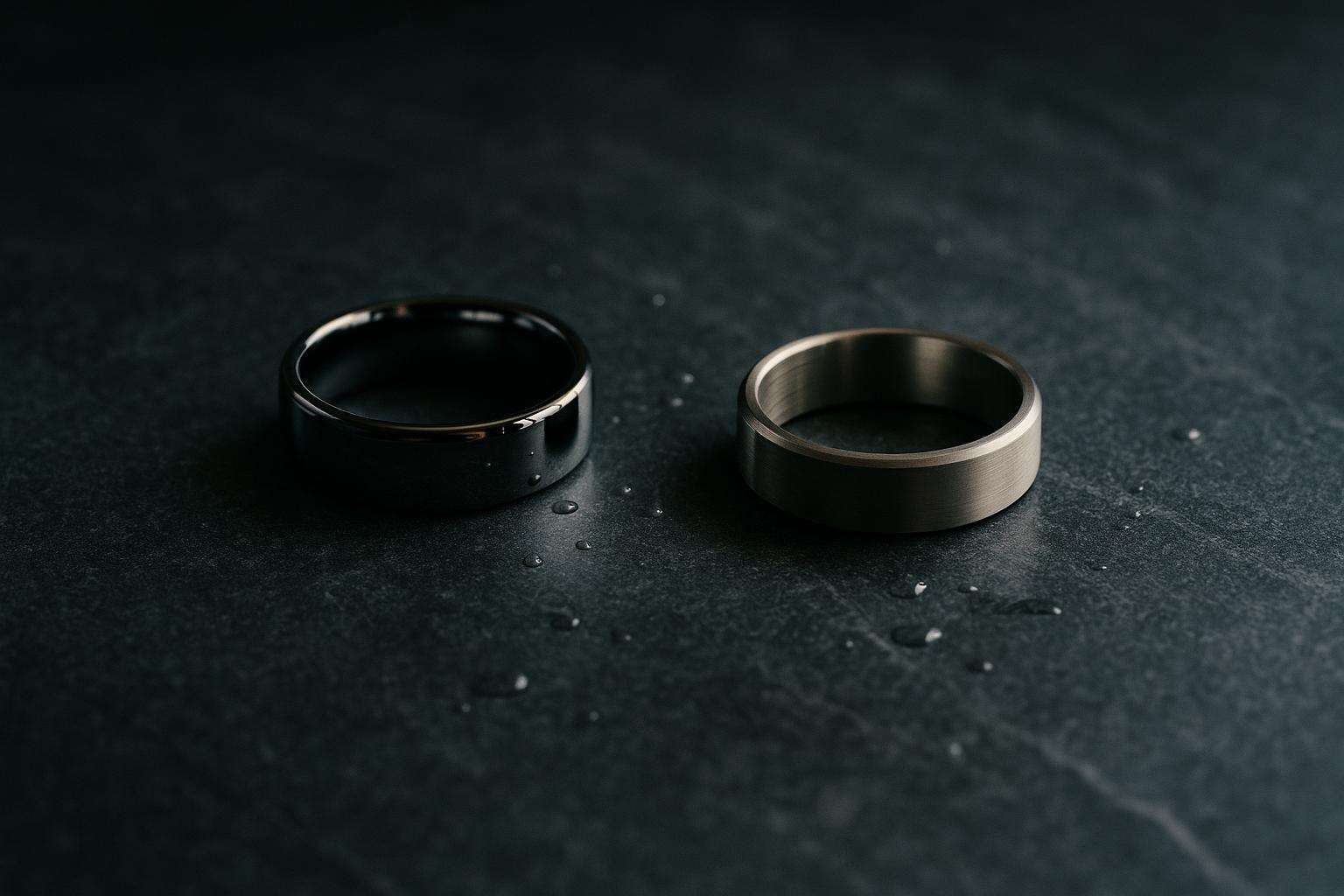
Tungsten is the harder, nearly scratch-proof choice that keeps a mirror finish for years — but it is brittle and can crack under a sharp blow. Titanium is far lighter and tougher, bending instead of shattering, which makes it the safer pick for high-impact work. Both come off safely in a medical emergency, neither can be resized, and both cost a fraction of gold. Choose by his hands and his work, not by hardness alone.
When you start researching his wedding band, two names surface again and again: tungsten and titanium. They are the most-searched modern metals for a reason — both are tougher and far cheaper than gold, and both look quietly handsome on a man's hand. But they are routinely confused, and they behave almost oppositely under stress. Understanding that one difference will tell you which belongs on his finger.
How hard are tungsten and titanium, and which one scratches more?
Hardness is the headline. Tungsten carbide measures roughly 8.5 to 9 on the Mohs scale — the standard scratch-hardness scale used in mineralogy — placing it just below sapphire and among the hardest materials used in any jewelry. In practice that means it shrugs off keys, concrete, glass, and steel tools, holding its polish for years. Titanium sits around 6 on Mohs: harder than gold or silver, but it will pick up fine surface scratches over time, especially on a man who works with his hands.
So if a permanently crisp, mirror-bright finish is what he wants, tungsten wins this category decisively. Titanium will still look good for years, but it shows its life — some men actually prefer that lived-in patina, the way a good watch earns its marks. As Van Adams Jewelers puts it, tungsten is about staying visually flawless, while titanium is about staying intact.
Can the ring crack or shatter, and does that matter for his lifestyle?
Here the two metals reverse, and it is the most important trade-off to understand. The very hardness that makes tungsten scratch-proof also makes it brittle. A sharp impact — a fall onto tile or concrete, a hard knock against a steel beam — can crack or even shatter a tungsten band. Titanium does the opposite: it is tougher, absorbing force by bending or deforming rather than fracturing.
This is why the right answer depends entirely on his hands. For an office worker or anyone whose ring rarely meets a hard surface, tungsten's brittleness is largely theoretical and almost never comes up. But for a man in a high-impact trade — construction, emergency services, heavy equipment — titanium's give is the genuinely safer trait. It is worth saying plainly, because the brittleness fact alarms people: a cracked tungsten ring is a known, inexpensive, replaceable event, not a danger to the finger.
How are tungsten and titanium rings removed in a medical emergency?
This is the question that worries partners most, often because of a stubborn myth that tungsten "can't be taken off." That is wrong. Both metals come off safely in an emergency — the methods simply differ.
Titanium is removed the familiar way, with a standard ring cutter — the same tool a jeweler or emergency room uses on a gold band. Tungsten is not cut but cracked off with vice grips or locking pliers: because the metal is non-malleable and brittle, concentrated pressure fractures it cleanly and the pieces fall away. A peer-reviewed study cited by Larson Jewelers and others clocked vice-grip removal at about 23 seconds, and most ERs and first responders already carry locking pliers. Safety glasses are advised, since shards can fly, and a cracked ring shouldn't be slid over the finger because of sharp edges. The reassuring bottom line: neither metal traps a finger when it counts.
| Factor | Tungsten carbide | Titanium |
|---|---|---|
| Scratch resistance | Outstanding (~8.5–9 Mohs) | Good (~6 Mohs) |
| Impact behavior | Brittle — can crack/shatter | Tough — bends, rarely breaks |
| Weight & feel | Dense, substantial | ~45% lighter, barely noticeable |
| Emergency removal | Cracked off with vice grips (~23 sec) | Cut with a standard ring cutter |
| Hypoallergenic | Usually (avoid cobalt-bonded) | Yes — biocompatible |
| Resizable | No | No (impractical) |
| Typical price | ~$150–$400 | ~$200–$600 |
How different do they feel, and what about sensitive skin?
Pick one of these rings up and the first thing he'll notice is weight. Titanium is about 45% lighter than tungsten, so a titanium band can feel almost weightless — a real comfort for a man who has never worn a ring and would rather forget it's there. Tungsten carries a dense, reassuring heft that many men read as premium. Neither is better; it is simply whether he wants to feel the ring or not. Both are widely sold in comfort-fit profiles, with a gently rounded inner edge that slides on and off more easily.
For sensitive skin, titanium is reliably hypoallergenic and biocompatible — a common recommendation for men with metal allergies. Tungsten is generally fine too, but it pays to choose nickel-free, organically bonded tungsten and avoid older cobalt-bonded versions, which can occasionally irritate skin.
What do they cost, and can he resize the ring later?
Both metals are dramatically cheaper than precious metals. Tungsten bands commonly run about $150–$400, titanium roughly $200–$600 (titanium is a touch pricier partly because it is harder to machine). At specialist retailers such as men's-ring specialists, most premium alternative-metal rings — including inlays of wood, carbon fiber, or meteorite — land in the $150–$500 range.
The one rule both metals share: neither can be resized. Tungsten is non-malleable and titanium is too hard to work conventionally, so getting his size right the first time is essential. Reputable sellers plan for this — many pair a free lifetime manufacturing warranty with a size-exchange policy — so confirm the exchange window and warranty in writing, and have his finger measured professionally at the time of day and temperature he'll usually wear it. Get the size right, match the metal to his work, and either ring will serve him beautifully for the long marriage ahead.
Frequently asked
Is tungsten or titanium better for a man who works with his hands?
It depends on whether his hands meet grit or impact. If he is around concrete, keys, and tools that would scuff a softer ring, tungsten's near-scratch-proof hardness keeps it looking crisp for years. But if his trade brings sharp blows or crush risk — construction, emergency response, heavy machinery — titanium is the wiser pick because it bends and absorbs impact rather than cracking. Many couples land on titanium for high-impact work and tungsten for an office or low-contact lifestyle. Either way, both are far more durable than gold, and a low-cost silicone backup band is sensible for the riskiest days on the job.
Can a tungsten ring really be removed in a medical emergency?
Yes, and the myth that it can't is one of the most persistent in jewelry. Tungsten is not cut like gold; instead it is cracked off with vice grips or locking pliers. Because the metal is brittle and non-malleable, concentrated pressure fractures it cleanly and the pieces fall away — a study cited by retailers measured the process at about 23 seconds. Most emergency rooms and first responders already carry locking pliers. Gentle Bands notes safety glasses are sensible since shards can fly. The finger is never trapped.
How is a titanium ring removed in an emergency?
Titanium is removed the conventional way — with a standard ring cutter, the same tool a jeweler or ER uses on a gold band. While titanium is much harder than precious metals, it is still cuttable, and emergency staff who are trained on ring removal can take it off without special equipment. This is one reason titanium is often recommended for men in injury-prone jobs: it gives responders a familiar, predictable removal path. As always, try elevation, ice, and a lubricant first if a swollen finger is the only problem.
Which ring feels heavier on the hand?
Tungsten, noticeably. Titanium is roughly 45% lighter than tungsten, so a titanium band can feel almost weightless — a real advantage for a man who has never worn a ring and doesn't want to be aware of it all day. Tungsten, by contrast, carries a dense, substantial heft that many men read as premium and reassuring. Neither is right or wrong; it comes down to whether he wants to feel the ring or forget it's there. If you can, have him try both weights in person before deciding.
Can either ring be resized later?
Generally no — and this is the single most important thing to get right before buying. Tungsten cannot be resized because it is non-malleable, and titanium is so hard that conventional resizing is impractical. That makes accurate sizing essential. The good news is that reputable retailers plan for it: Manly Bands, for example, pairs a free lifetime manufacturing warranty with size-exchange policies. Confirm the exchange window and warranty terms in writing, and have his finger measured professionally — ideally at the time of day and temperature he'll most often wear the ring.
Which is cheaper, tungsten or titanium?
Both are dramatically less expensive than gold, platinum, or palladium. Tungsten bands commonly run about $150–$400, while titanium tends to land a little higher at roughly $200–$600, partly because titanium is harder to machine. At specialist retailers, most premium alternative-metal rings — including inlays of wood, carbon fiber, or meteorite — sit in the $150–$500 range. For couples watching the budget, either metal frees up meaningful room elsewhere in the wedding without compromising on a durable, handsome band.