Fit & Tailoring
When to Order the Groom's Suit: A Month-by-Month Timeline
The order-by date that protects his wedding-day fit isn't a single number — it depends on the route. Here is the backward-planning timeline for rental, off-the-rack, made-to-measure, and bespoke.
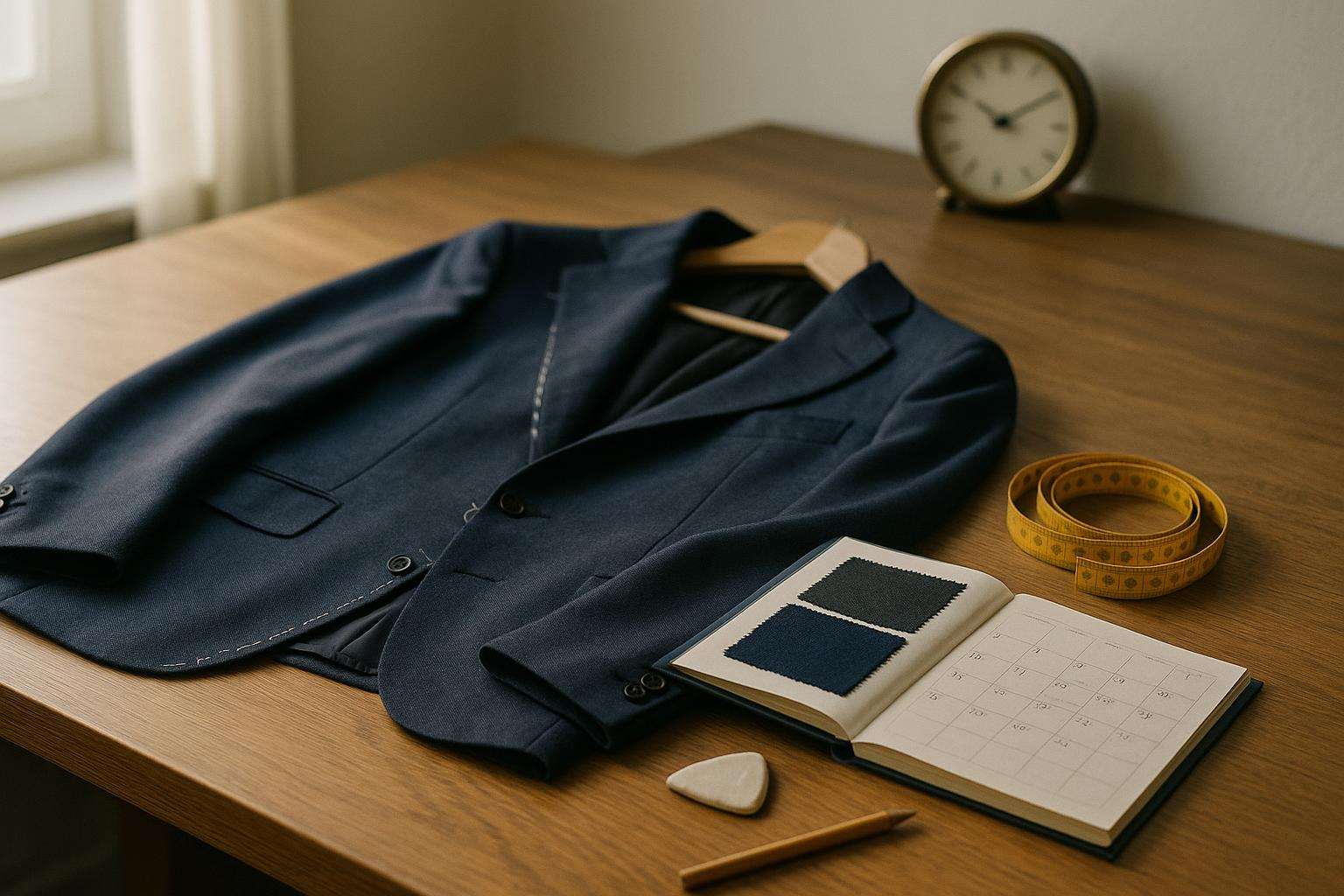
There is no single date to order the groom's suit — there are four, one per route. Reserve a rental five to eight months out, start a bespoke suit four to six months out, and give made-to-measure and off-the-rack roughly eight weeks each. Always plan backward from the wedding date and leave room for one round of corrections, so he is finished weeks early — not days.
If you are the one keeping the wedding on schedule, the groom's suit is one of the easiest things on the list to leave too late — it feels like a quick errand right up until it isn't. The reason it sneaks up on couples is that the right lead time is not a single number. It depends on how he is getting the suit, and each route runs on a very different clock. Reserve a rental too late and the inventory is gone; start a bespoke suit too late and there is no road left at all. The good news is that once you know which route he is taking, the order-by date becomes obvious, and the whole thing turns calm.
Below is the route-by-route breakdown, the master backward-planning timeline, and the one idea that matters more than any headline number: the buffer.
How far in advance should the groom order his suit?
Start by naming the route, because each carries its own production clock plus a fitting buffer. There are four common paths, and the order-by dates run from a few weeks to most of a year.
| Route | Order / book by (before the wedding) | Production / lead time | Final fitting target |
|---|---|---|---|
| Bespoke / custom tailored | 5–6 months | 12–18 weeks, 2–4 fittings | 3–4 weeks out |
| Made-to-measure (Indochino, Hockerty) | 8 weeks | 2–3 week build + remake buffer | 3 weeks out |
| Off-the-rack + alterations | 8 weeks | ~6–8 weeks of tailoring | 3 weeks out |
| Rental (The Black Tux, Generation Tux) | 5–8 months | ships 10–14 days out | try-on 10–14 days out |
The thread running through every row is a second-pass buffer. The first fitting rarely lands perfectly, and the entire point of starting early is to absorb one correction without ever touching the wedding date.
What is the timeline for a bespoke or made-to-measure suit?
Bespoke is the longest road and the one that punishes a late start most severely. A genuine hand-cut suit takes at least twelve weeks, and commonly twelve to eighteen, moving through a sequence of fittings the trade calls the baste, the forward, and the finish. Savile Row's Huntsman tells clients to expect fourteen to sixteen weeks from the first appointment and books at least four fittings; in peak season that can stretch toward five or six months. If he wants something made entirely for him, his first consultation belongs roughly five to six months before the wedding, with the last fitting a comfortable three to four weeks ahead.
Made-to-measure — the online route through houses like Indochino and Hockerty — is far quicker to build but deceptive on the buffer. Indochino ships online orders in two to three weeks via DHL, yet the company itself recommends ordering at least eight weeks before a big event so there is room to correct the fit, and it gives first-time buyers a fourteen-day claim window. Hockerty advertises a comparable two-to-three-week combined turnaround, but real-world remakes can run as long as six weeks — which is exactly why a wedding wants the eight-week cushion rather than the advertised three. The working rule for made-to-measure: order about two months out, and treat the first delivery as a fitting sample, not the finished article.
When should the groom rent a tux instead of buying?
Renting flips the math entirely: the constraint is inventory, not construction. The Black Tux recommends reserving a wedding rental five to eight months ahead, with six the sweet spot, because popular styles and the less-common sizes — a 34R, a 36S — sell through fastest in spring and summer season. A coordinated wedding party should book at least four months out to hold full style selection, every size, and free shipping at once. The look itself arrives ten to fourteen days before the event, which leaves a real window for a home try-on and a free exchange if something is off; the practical last-minute floor is a seven-to-ten-day booking. Generation Tux gives near-identical guidance: reserve early, try on two weeks out, swap if needed. Renting is the right call when he wants a coordinated party, a one-time black-tie look, or a light suitcase for a destination wedding.
What is the order-by date for off-the-rack with alterations?
Buying ready-to-wear from a retailer such as Suitsupply or Brooks Brothers puts the suit in hand the same day — but a wedding-grade fit still needs a tailor, and good alterations almost always take two passes. Allow about six to eight weeks. The sequence is straightforward: buy and book the first alteration appointment around eight weeks out, do the first fitting near six weeks, return for a confirmation fitting around three weeks, and collect with a week to spare. That cadence has a quiet second benefit — it leaves room to catch a late weight change, which is common when a groom takes up a pre-wedding fitness push or simply tightens up under planning stress. A suit pinned eight weeks out and confirmed at three fits the man who actually walks down the aisle.
Why does the buffer matter more than the headline lead time?
The headline number is always the happy path. Two to three weeks for Indochino assumes nothing needs fixing; ten to fourteen days for a rental assumes the size is right out of the box. The real risk lives in the correction cycle — an Indochino claim, a Hockerty remake, a tailor's second fitting — and every route's official guidance quietly bakes in extra time precisely because of it. That is why Indochino says eight weeks for events and The Black Tux ships ten to fourteen days early. The groom who orders at the bare minimum has zero margin if anything is off. The one who orders a month earlier is simply done, and can spend the final stretch thinking about the vows instead of the trouser break.
Anchor everything to the date. Six months out, decide the route and reserve any destination or peak-season rental. Four to five months out, begin bespoke fittings. Three months out, place the made-to-measure order. Two months out, buy off-the-rack and book the first alteration. One month out, the party completes its rental checkout. Two weeks out, everything is in hand and tried on within a day. Plan it backward, build the buffer, and the suit stops being a deadline and becomes one of the calm, settled parts of the day.
Frequently asked
How far in advance should the groom order his suit?
It depends entirely on the route he takes. A rental should be reserved five to eight months out (six is the sweet spot) because inventory, not construction, is the constraint. A bespoke suit needs four to six months for its multiple fittings. Made-to-measure online and off-the-rack-plus-alterations each want roughly eight weeks — not because they take that long to build, but to leave a buffer for one round of corrections. The unifying rule is to plan backward from the wedding date and to leave room for a second fitting, so the suit is finished with weeks to spare rather than days.
How long does a made-to-measure suit from Indochino or Hockerty actually take?
The build is fast; the safe window is not. Indochino ships online orders in two to three weeks via DHL, yet recommends ordering at least eight weeks ahead of a big event so there is time to correct the fit, and gives first-time buyers a 14-day claim window. Hockerty advertises a two-to-three-week combined turnaround, but a remake can run as long as six weeks. Treat the first delivery as a fitting sample and order about two months out.
When should the groom rent a tux instead of buying one?
Renting makes sense for a coordinated party, a one-time formal look, or a destination wedding where carrying a suit is impractical. The trade-off is timing: The Black Tux advises booking a wedding rental five to eight months ahead, with six months ideal, because the less-common sizes — a 34R, a 36S — sell through first in spring and summer. The rental arrives ten to fourteen days before the event, leaving a real window for a home try-on and a free exchange. A wedding party should book at least four months out to keep full style selection and free shipping.
How much time do off-the-rack alterations need before the wedding?
Plan on about six to eight weeks. The suit is in hand the day it is bought from a retailer like Suitsupply or Brooks Brothers, but a wedding-grade fit still requires a tailor, and good alterations usually take two rounds. Buy and book the first appointment around eight weeks out, do the first fitting near six weeks, return for a confirmation fitting around three weeks, and collect with a week to spare. That sequence also leaves room to catch a small weight change in the final stretch — common with the gym push or the pre-wedding stress that many grooms experience.
What is the longest lead-time route, and how early must he start?
True bespoke is the longest road. A hand-cut suit takes at least twelve weeks and commonly twelve to eighteen, across two to four fittings — the baste, the forward, and the finish. Savile Row house Huntsman tells clients to expect fourteen to sixteen weeks from the first appointment, longer in peak season. A groom going bespoke should have his first consultation roughly five to six months before the wedding, with the final fitting comfortably three to four weeks ahead so there is no scramble at the end.
What if the wedding is only six weeks away?
Six weeks rules out bespoke and makes online made-to-measure risky, because there is no margin for a remake. The reliable routes at that range are off-the-rack with rushed alterations from a shop that does in-house tailoring, or a rental — services like Generation Tux and The Black Tux can still outfit a last-minute order, with a practical floor of about seven to ten days. Buy or reserve immediately, prioritize a clean fit over a perfect color match, and keep the alterations list short so the tailor can turn it quickly.