Fit & Tailoring
Off-the-Rack vs Made-to-Measure vs Bespoke: The Groom's Decision
The three ways to dress him for the aisle, compared on fit, cost, lead time, and reuse — so you can match the route to your calendar and your budget.
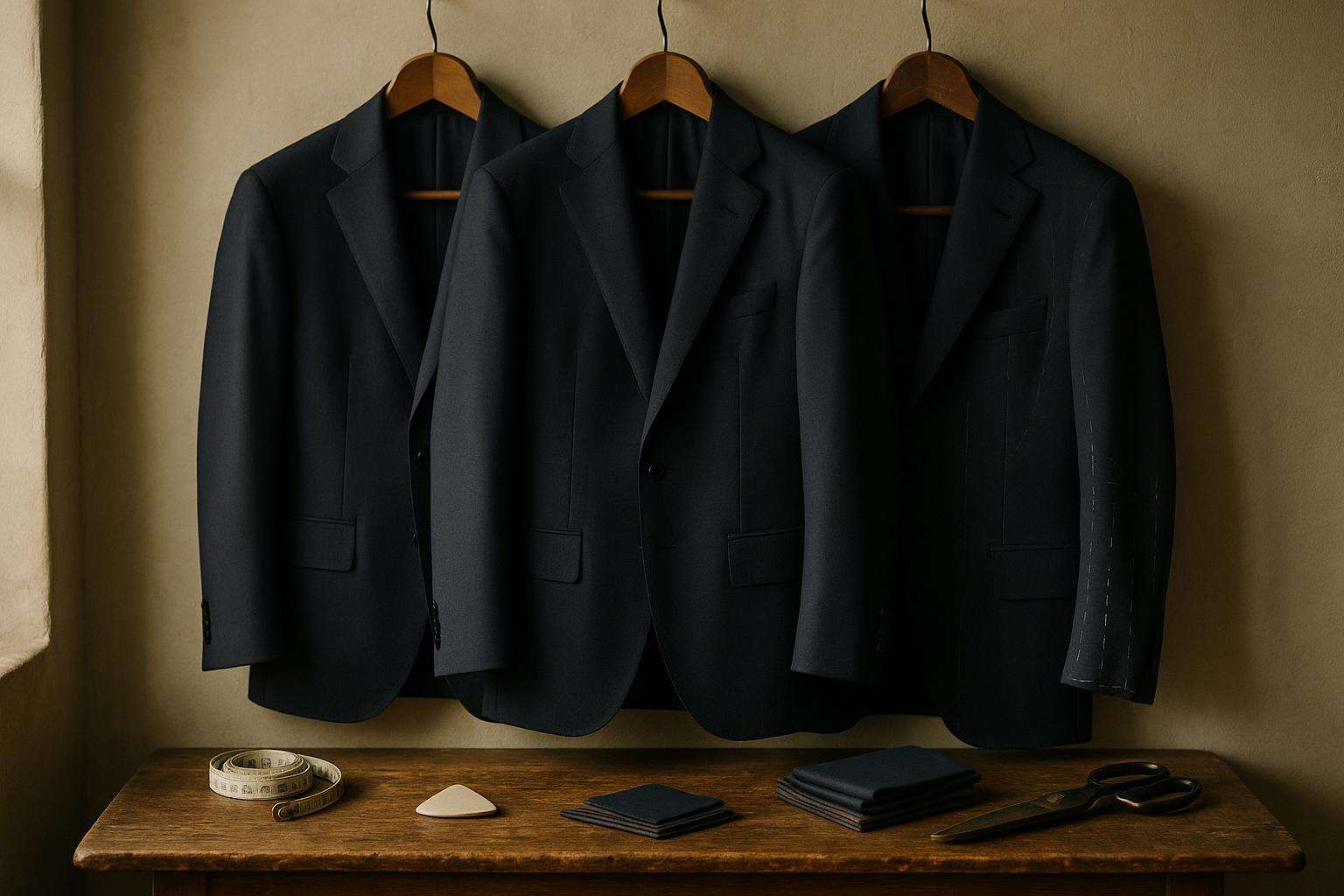
The three suiting routes differ above all in how the pattern is made. Off-the-rack alters a finished stock suit — fastest and cheapest. Made-to-measure adapts a house pattern to his measurements — the best balance of fit, cost, and time, and the right call for most grooms. Bespoke drafts a pattern from scratch over several fittings — the finest fit, the longest wait, the highest cost. Choose by two questions: how many weeks remain, and whether he will wear the suit again.
When you start shopping for the suit he will wear at the front of the room, you will meet three words that sound interchangeable and are not: off-the-rack, made-to-measure, and bespoke. They are not just three prices — they are three entirely different ways of building a suit, and the right one for your wedding depends as much on the calendar on your wall as on the figure in your budget. Here is how the tiers actually compare, and how to match one to your day.
What actually separates off-the-rack, made-to-measure, and bespoke?
The dividing line is the pattern, not the label. Off-the-rack (also called ready-to-wear) is a finished suit built to a standardized size and hung on a rail; a tailor then alters it to him. Made-to-measure starts from an existing house pattern that is adjusted to his measurements and preferences, then cut and sewn — usually by machine — to that specification. Bespoke drafts a brand-new paper pattern from scratch, often from thirty or more measurements plus his posture and stance, then hand-cuts and largely hand-sews the suit across a series of fittings.
Construction usually tracks the tier. Most off-the-rack suits are fused — the inner canvas is glued to the wool with heat, which is cheaper and faster — while bespoke is fully canvassed and hand-finished, with a Savile Row coat carrying sixty to eighty hours of work. A useful exception worth knowing: SuitSupply uses half-canvas construction at a ready-to-wear price, which is why it punches above its tier for grooms who want quality without the bespoke wait.
How much does each route cost a groom?
Prices move with sales and fabric, so treat these as ranges rather than quotes. Off-the-rack runs roughly $200 to $800 by brand, plus $50 to $150 in basic alterations; at SuitSupply specifically, entry suits sit near $599 and the realistic all-in after alterations and tax lands closer to $720 to $800. Made-to-measure has been transformed by the online brands: Indochino advertises custom suits from about $499 (often discounted further on sales), while in-store and traditional MTM climbs past $1,000 and well beyond. Bespoke typically costs $3,000 to $10,000 or more, with most landing between $3,500 and $6,000.
| Factor | Off-the-Rack | Made-to-Measure | Bespoke |
|---|---|---|---|
| How the pattern is made | Finished stock size, then altered | House pattern adjusted to him | New pattern drafted from scratch |
| Fit | Good with alterations | Personal, measurement-based | Truly unique to his body |
| Typical cost | $200–$800 (+ alterations) | ~$499 online to $1,000+ in store | $3,000–$10,000+ |
| Lead time | Immediate (alter in days) | ~3–8 weeks | 12–18 weeks |
| Real examples | SuitSupply, department stores | Indochino, Hockerty, SuitSupply Custom Made | Huntsman, local bespoke tailors |
| Best for the groom who… | Is short on time or budget | Wants the best balance — most grooms | Wants an heirloom and has the runway |
How long does each take, and will the calendar allow it?
For a groom, time is often the real decider. Off-the-rack is available immediately, and basic alterations take days to about two weeks — SuitSupply's in-house tailors can frequently turn a suit around same-day or next-day. Made-to-measure through an online brand such as Indochino runs roughly three to four weeks; in-store MTM takes about four to eight weeks, plus a window for a remake if the first version needs adjusting. Bespoke stretches twelve to eighteen weeks across multiple fittings, with houses like Huntsman aiming to deliver fourteen to sixteen weeks from the first appointment.
The planning takeaway is simple: bespoke must be commissioned about four to five months out, made-to-measure about two to three months out, and off-the-rack can rescue a groom who left it late. If you are reading this with the wedding inside a month and nothing ordered, off-the-rack with a sharp tailor is your friend — not a failure.
Which option fits a groom best?
Match the route to two questions: how many weeks remain, and whether he will wear the suit again. A groom who wants a sharp look he can try on in person, with near-zero risk of a remote-fit miss, is well served by quality off-the-rack and a good tailor — just confirm the shoulders, chest, and seat fit cleanly on the rack, because those are the parts a tailor cannot easily change. A groom who wants a personal fit, his own choice of cloth and lapel, and some price flexibility — and who has eight to twelve weeks — is the classic made-to-measure customer, which is why MTM has become the default for weddings. And a groom who wants an heirloom, a once-in-a-lifetime fit, and has both the months and the budget is the bespoke case. For a deeper read on the tiers, Hockerty's comparison and The Knot's made-to-measure guide are both worth a look.
One last factor quietly tips the math: reuse. A navy or charcoal made-to-measure or bespoke suit re-enters his wardrobe for years, lowering the cost-per-wear until the upgrade pays for itself; a one-off rental does not. If the wedding suit will live on past the day, paying up is far easier to justify than the sticker alone suggests — and a groom who feels at ease in something built for him tends to look it, in every photograph you will keep.
Frequently asked
Is made-to-measure worth it for a wedding suit?
For most grooms, yes — made-to-measure is the sweet spot. It gives him a fit built to his own measurements and his pick of cloth, lapel, and lining, at a price that now starts near $499 online with brands like Indochino. The catch is time: budget roughly three to four weeks for online MTM, and longer for in-store. If the wedding is more than two months out and you want him to feel the suit was made for him in the photographs, MTM repays the small premium over off-the-rack handsomely.
How far in advance should a groom order his suit?
Work backward from the tier. Bespoke needs the most runway — commission it about four to five months out, because multiple fittings stretch the build to twelve to eighteen weeks. Made-to-measure wants roughly two to three months, leaving room for a remake if the first version needs a tweak. Off-the-rack can be sorted in a couple of weeks, since alterations are quick. A safe rule: start shopping the moment the venue and formality are locked, and never let a groom's suit slip inside the final month if he is going custom.
What is the difference between made-to-measure and bespoke?
The difference is the pattern. Made-to-measure adjusts an existing house block pattern to his measurements and is sewn largely by machine. Bespoke drafts a brand-new pattern from scratch — often from thirty or more measurements plus his posture and stance — then hand-cuts and hand-sews it across several fittings. As Huntsman describes it, bespoke is built and refined on the body over multiple appointments. The result is a more precise, softer-shouldered fit, at several times the cost and lead time.
Why are off-the-rack suits cheaper?
Two reasons: standardization and construction. An off-the-rack suit is mass-produced to a stock size, so the labor is spread across thousands of identical garments rather than one. And most off-the-rack suits are fused — the inner canvas is glued to the wool shell with heat instead of stitched, which is faster and cheaper. A welcome exception is SuitSupply, which offers half-canvas construction at a ready-to-wear price. Off-the-rack typically runs $200 to $800 before alterations.
Can an off-the-rack suit ever look custom?
It can — if you start with the right bones and use a good tailor. The parts a tailor cannot easily change are the shoulders, the chest, and the seat, so make sure those fit cleanly on the rack before buying. Everything else — sleeve length, trouser hem, waist suppression, taking in the back seam — is routine alteration work that turns a decent off-the-rack suit into one that reads as made for him. Set aside $50 to $150 for it. SuitSupply's in-store tailors can often do same-day or next-day fixes, which is a real advantage when the calendar is tight.
Will he wear the wedding suit again?
That single question reshapes the budget. A classic navy or charcoal suit — whether off-the-rack, made-to-measure, or bespoke — re-enters his wardrobe for years of work, dinners, and other weddings, so the cost-per-wear quietly falls. A novelty color or a rental does not. If the suit will live on, paying up for made-to-measure or bespoke is far easier to justify than the sticker alone suggests. If it is a one-time, very formal look he will never repeat, a well-tailored off-the-rack suit or a rental may be the wiser spend.